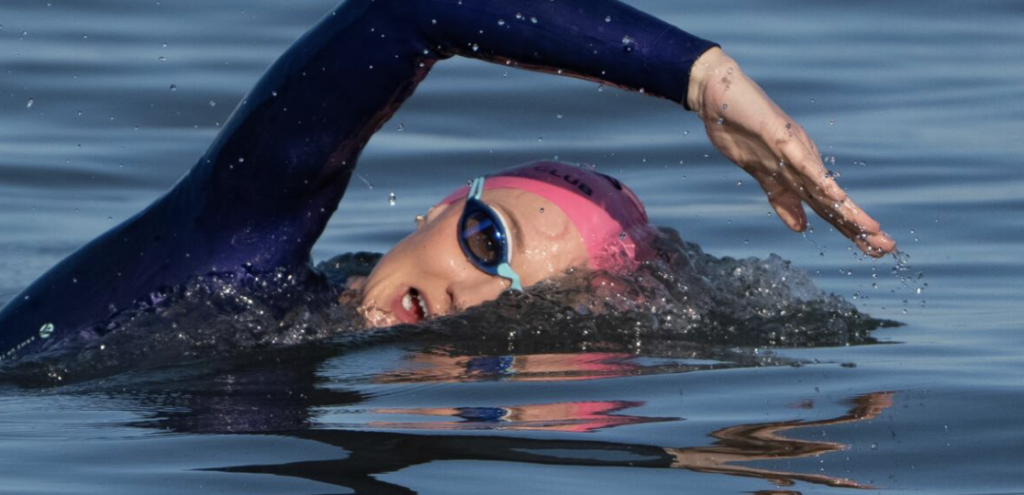
Catherine Breed (31, USA, MSF bio here, @catherine.breed) reversed direction, at least for one stage swim, during her 1,448 km Swim California event. Her solo coastal swim from Pelican State Beach in Del Norte County along the California-Oregon border to Imperial Beach in San Diego County along the California-Mexican border is an unprecedented assisted stage swim.
It is audacious, adventurous, and ambitious.
Breed’s goal is to inspire girls and women and to call attention to preserving the marine environment – and has gained national media attention and international legion of fans.
She explained her Day 19 update on her Instagram feed, “Today, we made the extremely difficult decision to reverse part of our swim.”
Breed swam 4 miles south as planned, but then swam 4 miles north in an unexpected deviation to her original announced plan. She continued, “We did a little switchback. It is still my intention to swim every single inch of this coastline. There just may be some sections that we do in the opposite direction to make this possible…This was one of the hardest decisions that I had to make, but it really falls into safety…The precedent is set in open water swimming and it was a safety call.“
She discussed the precedent, “There have been a few open water swims around the world, in Iceland, in Ireland…those swims have gone in the opposite direction. So the precedent is there. I did not want to do it, but I made it as a last resort.“
What Is A Stage Swim?
Before explaining what Breed’s precedent is, it is important to know what a traditional stage swim is. During a stage swim, as it has been conducted by many swimmers over the past several decades, swimmers swim in one direction every day over the course of many weeks or months to traverse vast distances. The most prominent and well-known stage swimmers have swum in rivers (a la Martin Strel down the Amazon), in lakes (a la Malia Metella, Théo Curin, and Mathieu Witvoet across Lake Titicaca), across channels (a la Lewis Pugh along the English Channel), in seas (a la Daragh Morgan around Ireland), or in oceans (a la Ross Edgley around Iceland).
In these traditional stage swims, the swimmer begins the swim on each day or period at the exact point where the swim on the previous day finished. Basically and specifically, the swimmers traverse from point to point to point, from start to finish.
The stage swims can be defined as continuous stage swims where they swim once every 24 hours. If they cannot swim every day, then the swim is defined as a non-continuous stage swim.
The stage swims are also be defined by their nature as contiguous swims. That is, the swimmers cover every kilometer along their intended course. In the case, that the swimmer cannot for any reason swim from point to point to point, then the swim is defined as a non-contiguous stage swim. In these cases, there is a disconnect between contiguous points along their course, perhaps due to the topography of the land, risk factors, unsafe water conditions, or or weather conditions.
When the stage swims are along a circumnavigation course, the swimmers either traverse going in either the clockwise or counterclockwise direction. When the stage swims are along a point-to-point course, the swimmers traverse in one direction, either north or south, or east or west. These are called uni-directional courses.
The rules of the myriad types of stage swim have been in place and followed throughout the history of the sport.
What Is The Precedent?
Breed discussed the precedent, “There have been a few open water swims around the world, in Iceland, in Ireland…those swims have gone in the opposite direction. So the precedent is there.“
The precedent was officially governed and ratified by Pat Gallant-Charette, Dan Simonelli, Paul Georgescu, and David Rich for the Great Icelandic Swim by Ross Edgley. Edgley, like Breed, was attempting and completed an unfathomable stage swim around the coastline of Iceland, a massive swim of 1,600 km that began in May 2025 in 6-7°C water temperatures. The ratification enabled Edgley to receive another Guinness World Record in his prolific career of unprecedented swimming feats.
Edgley’s swim was rough and tough. There was nearly always drama along the course and nearly trauma. For over two months, Edgley and his support team were getting pounded by rough seas and strong winds. Ultimately about 75% around Iceland, Edgley’s team made the decision to motor to the finish point and then swim back to the switchback point.
Edgley’s swim was defined as a bi-directional, non-contiguous, non-continuous assisted stage swim around the island of Iceland that started on May 31st and ended in November 2025.
Similar to Edgley’s switchback and bi-directional nature of his stage swim, Breed’s decision was due to safety. As she explained, “We did a little switchback. It is still my intention to swim every single inch of this coastline. There just may be some sections that we do in the opposite direction to make this possible…This was one of the hardest decisions that I had to make, but it really falls into safety…The precedent is set in open water swimming and it was a safety call.“
Gallant-Charette, Simonelli, Georgescu, and Rich similarly made the unexpected call to approve and ratify Edgley’s swim due to safety.
Edgley took 114 days – or nearly 4 months – to complete his Great Icelandic Swim, an open water swimming feat that may never be again attempted or completed in history. Similarly, Breed is on her way – now on Day 20 – to complete her Swim California stage swim – another feat that may never be again attempted or completed in history.
Precedents in Ireland
There were two well-known stage swims in Ireland – Daragh Morgan‘s 1,600 km non-continuous Swim Éire in 2025 and the 56-day Round Ireland Swim by Anne Marie Ward, Ryan Ward, Tom Watters, Ian Claxton and Nuala Moore with expedition leader Henry O Donnell in 2006. But while these both stage swims were non-continuous, it is unknown if they were bi-directional at this time (to be confirmed).
Marathon Swimmers Federation Tracker
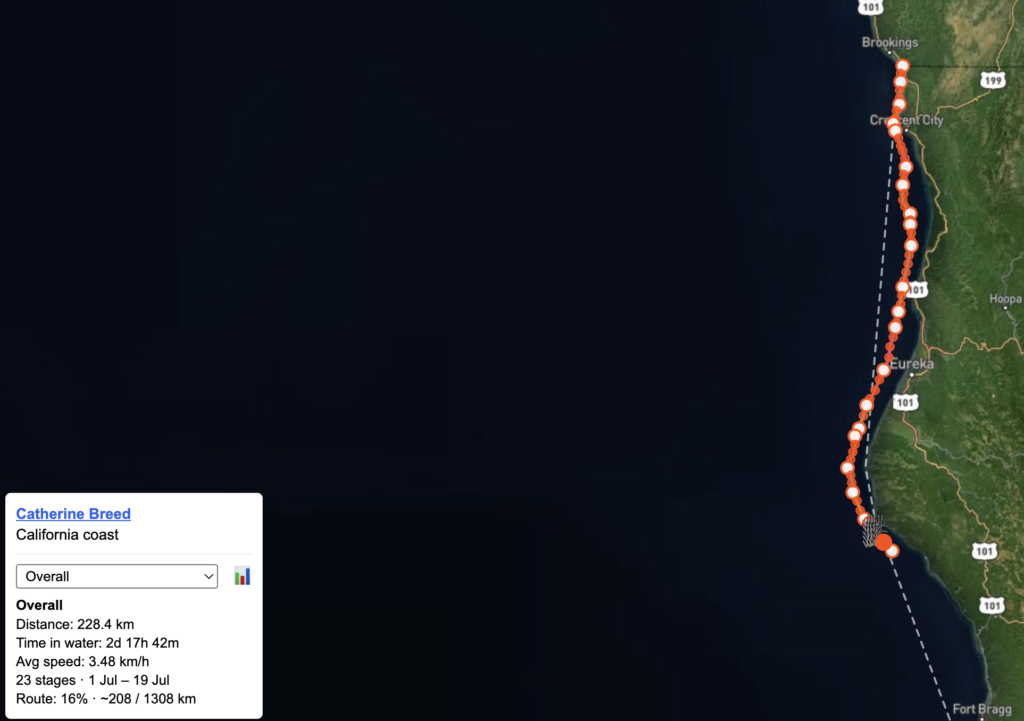
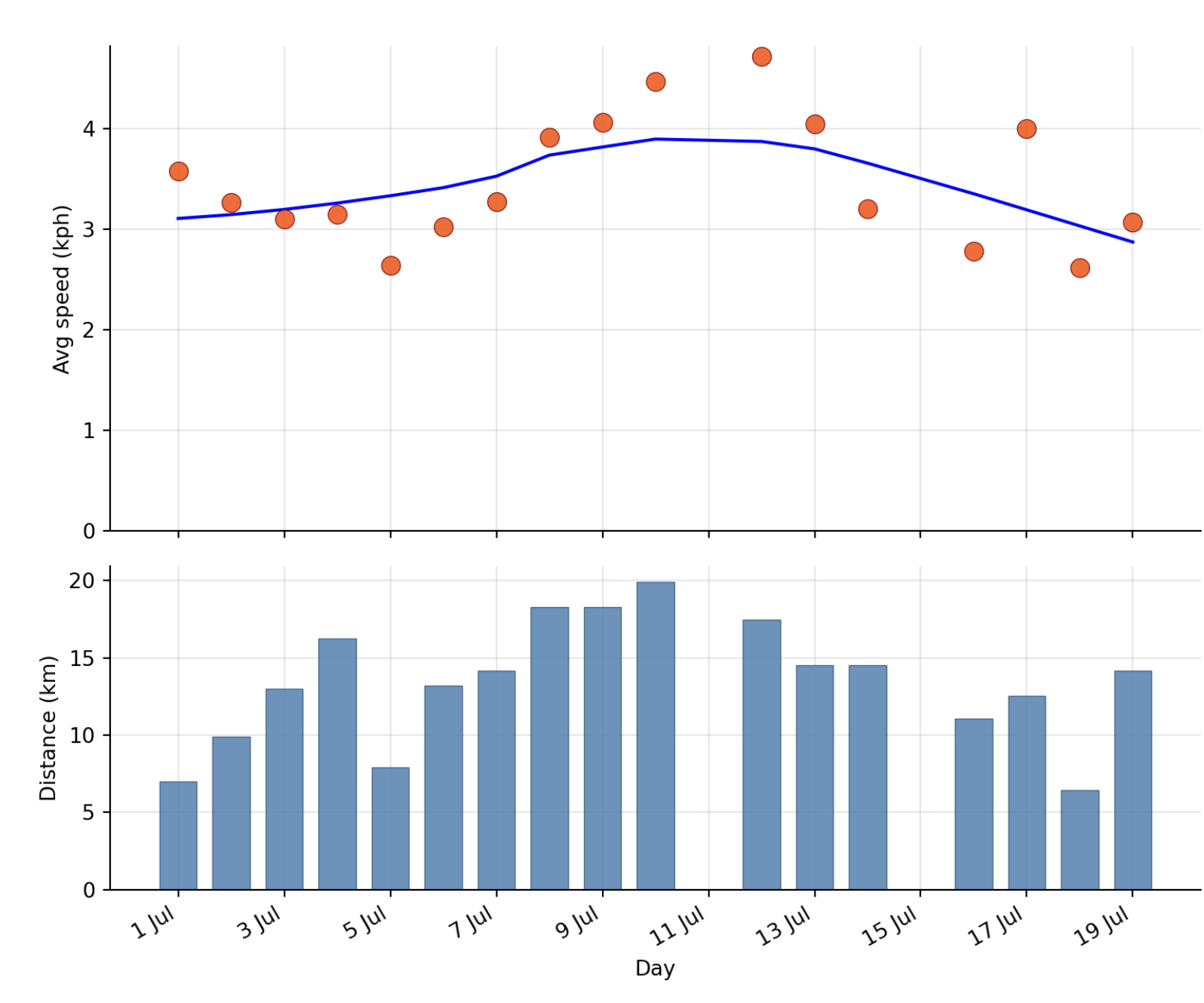
For an independent view of her progress to date, the Marathon Swimmers Federation is following her progress down (and up) the coast of California. See the MSF tracker here. A snapshot of the Marathon Swimmers Federation tracker after Day 19 is shown below.
Start and Finish
Breed remains on track to swim from Pelican State Beach located on the northern California and Oregon border [see below on left] to Imperial Beach in San Diego County that sits along the California-Mexican border [see below on right].


Sea Dreamers
For more information on the Sea Dreamers, visit seadreamers.org. For more information on Swim California, visit here.
© 2026 Daily News of Open Water Swimming
“to educate, enthuse, and entertain all those who venture beyond the shoreline“
World Open Water Swimming Federation, a human-powered project
I think the most important thing is for the swimmer, observer, organization to be clear and honest about the actual event. The classic marathon involves a small (non buoyant) swim suit, goggles, ear plugs, some grease and one latex caps, bans contact with the swimmer (except for non-human contact) for feeds, and shote in/out. Make clear any variations. I am quick to applaud all big swim/adventures…..but I go quiet when variations are not disclosed.
A good starting point to see differences can be found on this page (which has evolved over the last 20 years):
https://www.openwaterpedia.com/wiki/Stage_swim#Types_of_Stage_Swims