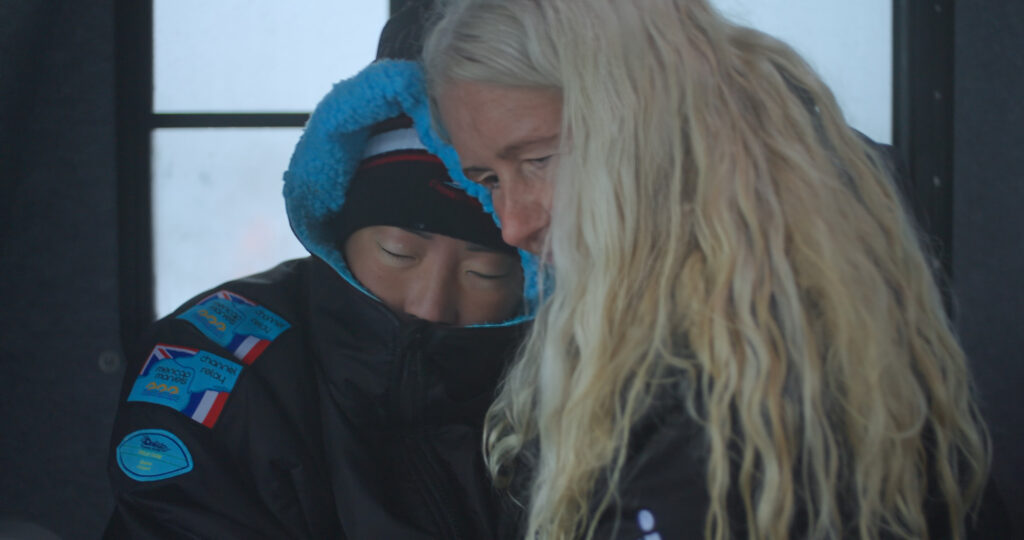
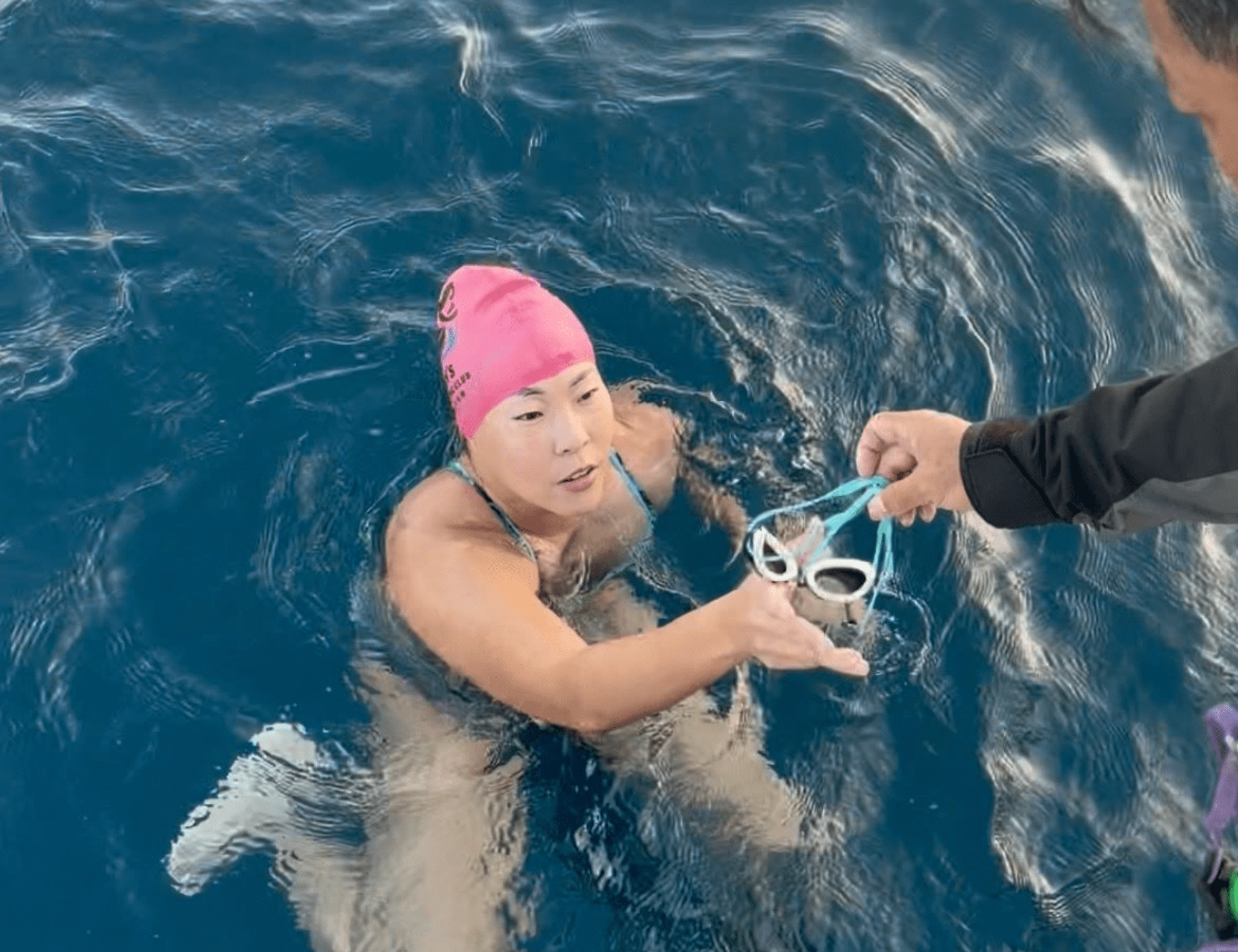
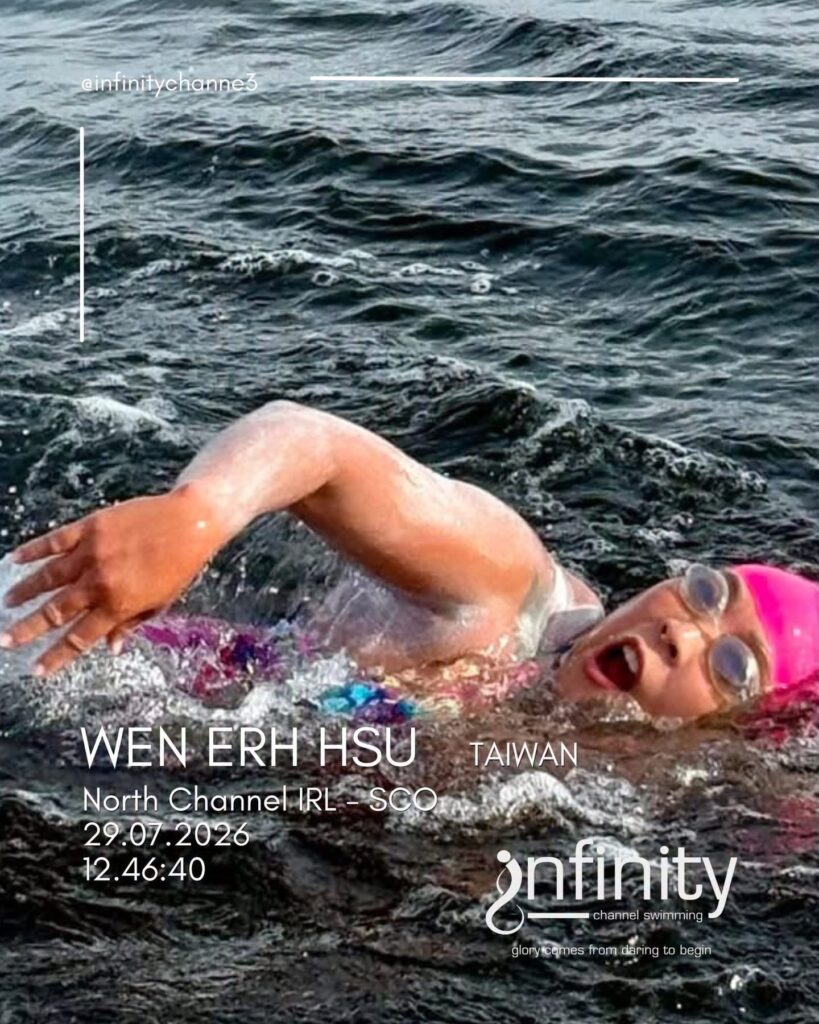
Triple Crown swimmer and open water coach Wen-Erh Hsu (30, Taiwan, MSF bio here, @wen_swims_the_channel) completed the first 35 km crossing of the North Channel by a Taiwanese swimmer. She crossed in 12 hours 46 minutes from Northern Ireland to Scotland under the escort of Jacqueline McClelland of infinity Channel Swimming and observer Leon Reed.
But it was not easy.
She writes about her suspected SIPE episode during the crossing, focusing on what it actually felt like as it developed and why she did not recognize it at the time. “As an open water swimming coach and advocate, I believe that while we encourage more people to take part in this sport, we also have a responsibility to help make it safer. Sharing experiences like this is an important part of building greater awareness and giving the swimming community the knowledge to recognise potential warning signs.
Talking about SIPE is not intended to frighten people away from open water. It is about helping swimmers, coaches and crews understand the risks, respond appropriately and prevent avoidable tragedies.
We Had All Heard of SIPE. I Still Didn’t Recognize It When It Happened to Me
By WenErh Hsu
Most experienced open water swimmers have heard of swimming-induced pulmonary edema, or SIPE. We know it involves fluid accumulating in the lungs and can become life-threatening.
But knowing the definition is not the same as recognising SIPE when it is happening inside your own body.
During my North Channel swim, I discovered how wide that gap can be.
I am an experienced channel swimmer, coach and open water advocate (English Channel in 12 hours 7 minutes + Catalina Channel in 13 hours 21 minutes + 20 Bridges in 9 hours 5 minutes + Lake Windermere in 5 hours 17 minutes + Strait of Gibraltar in 6 hours 3 minutes + Taiwan Strait in 7 hours 24 minutes + Cold Half in 5 hours 11 minutes). Having completed several major crossings, I am accustomed to cold, darkness, fatigue and rough seas. I thought that experience would help me recognize when something was seriously wrong.
Yet when SIPE most likely developed during the final hours of my North Channel crossing, I did not recognize it. Neither I nor my crew understood what was happening. I thought I had swallowed or inhaled seawater.
Because that explanation seemed ordinary, I kept swimming.
When the North Channel changed, I started from Northern Ireland at 3 am. The first eight hours were extraordinary: relatively calm 15.3°C water, with
dolphins and hundreds of jellyfish beneath me. I swam hard with the favorable tide and made most of my progress.
Then the conditions changed quickly.
The wind rose, heavy rain arrived and the sea became rough. The water temperature fell to approximately 13.7°C. I became cold and sleepy, so we shortened my feeding interval to every 20 minutes to provide warm fluid more often. However, we did not reduce the volume of each feed. This increased my hourly fluid intake and may have pushed an already stressed body over the edge.
During the final three hours, I began to cough.
At first, it did not seem dramatic. Open water swimmers often cough after a mistimed breath or inhaling spray. I assumed water had simply gone down the wrong way. But the cough did not stop.
I did not want to alarm anyone on the boat, and I did not want to complain about being uncomfortable, so I tried to hide it by coughing underwater. Every time I took a breath and turned my face back into the water, I coughed. It felt as though fluid kept rising into my throat and constantly needed to be cleared.
I had swum through many kinds of severe weather and rough seas, but I had never experienced a cough like this. As my breathing grew heavier, I could no longer maintain my normal rhythm. Eventually, I had to breathe on every single stroke, then turn back into the water and cough again.
The frightening part was not one sudden failure, but the gradual loss of something normally automatic. My arms still moved, yet breathing demanded increasing effort and I began to hyperventilate.
As marathon swimmers, we train ourselves to endure pain, cold, nausea, exhaustion and doubt. We learn not to complain and not to stop simply because something hurts. That resilience is essential to completing a channel swim—but it also made this danger easier to rationalize. With Scotland only two kilometers away, I did not ask, “Is this a medical emergency?” I asked, “Can I tolerate this a little longer?”
I believed I could.
What SIPE actually felt like
SIPE is often described through clinical signs: coughing, breathlessness, low oxygen levels and sometimes pink, frothy or blood-stained sputum. But those words do not fully describe the experience. For me, it felt like drowning slowly while I was still swimming.
It was not violent choking after one large inhalation of water. Every breath simply became less effective. Breathing faster never provided enough air, and being horizontal seemed to make it worse.
During the final 500 meters, I changed to breaststroke because I could no longer breathe adequately while swimming freestyle. Lifting my head and becoming slightly more upright helped just enough for me to continue towards the rocks.
I completed the crossing. On the boat, however, I coughed up pink, blood-streaked sputum. That was the first sign that made me realize this had not been an ordinary episode of swallowing seawater. I also realized that I had not urinated for approximately four hours despite continuing to drink. After leaving the water and becoming upright, my breathing gradually improved. When I later began urinating again, the coughing also settled.
That night, I could not lie flat without coughing and had to sleep partly upright. It took roughly 72 hours before I could lie down and wake without the urge to cough.
I sought medical help after returning to land, but after waiting around four hours, I was not assessed by a doctor. I therefore have no imaging or acute diagnosis. Based on the symptom pattern, SIPE was considered the most likely explanation afterwards, so I describe this as a suspected rather than confirmed episode.
Why SIPE may be missed
SIPE may occur more often than reported figures suggest. Symptoms can improve quickly after leaving the water, becoming upright and passing urine. Some swimmers therefore never seek care; others arrive only after the acute signs have faded, making confirmation difficult.
After I shared my experience, many swimmers described similar symptoms, but had never considered SIPE. Some recovered after leaving the water; others continued, assuming they had swallowed water.
Awareness must go beyond knowing the name. Swimmers and crews should recognize the pattern: persistent or worsening coughing, repeatedly needing to clear fluid, breathlessness out of proportion to the effort, breathing on every stroke, difficulty breathing while horizontal, and pink, frothy or blood-stained sputum.
Not every cough is SIPE, but persistent coughing combined with worsening breathing should never be dismissed as routine.
SIPE can affect fit, experienced swimmers. Cold water and excessive fluid loading are recognized potential contributors. Suspected SIPE requires the swim to stop and urgent medical assessment, even if symptoms improve after leaving the water.
Why I kept swimming—and why the crew must be ready to act
It is easy to say I should have stopped. Knowing what I know now, I agree. Had I understood that the coughing and breathlessness could mean fluid was accumulating in my lungs—and that continuing could be fatal—I would have ended the swim.
I had experienced rough conditions and inhaled seawater before. I could still move and the finish was close, so I believed the problem was manageable. Persistence is an endurance swimmer’s strength, but in an emergency it can become a liability. By coughing underwater, I also made the danger harder for my crew to see.
Before a major swim, the team should agree that persistent coughing with deteriorating breathing is a medical warning, not a test of toughness. The decision to stop should not depend on an exhausted, cold and possibly hypoxic swimmer recognizing the danger first.
The lesson I brought home
The North Channel was one of the most important swims of my life. I am proud that I crossed it, but the final two kilometers could have ended differently. The experience did not make me afraid of open water; it showed me how quickly a strong swimmer can move from discomfort to danger. As a coach and open water advocate, I want more people to discover this sport—and I want it to become safer. Discussing SIPE is not about frightening people away. Better knowledge helps us recognize danger, respond sooner and pursue extraordinary goals without creating avoidable tragedies.
We have all heard of SIPE. That is not enough. We need to understand what it can feel like: the cough that seems ordinary at first; the constant sensation of fluid that needs to be cleared; the breaths that become faster but less satisfying; and the deceptive belief that because you are still moving, you must still be safe.
Most importantly, we need to understand that stopping is not a failure when the lungs are no longer working normally. In that moment, getting the swimmer out of the water is not giving up on the swim.
It is bringing the swimmer home.
Author’s note
This article describes the author’s personal experience and a suspected episode of SIPE. It is not medical advice. Any swimmer who develops new or worsening breathlessness, persistent coughing, pink or blood-stained sputum, confusion, chest discomfort or other signs of respiratory distress during or after immersion should leave the water and receive urgent medical assessment.
© 2026 Daily News of Open Water Swimming
“to educate, enthuse, and entertain all those who venture beyond the shoreline“
World Open Water Swimming Federation, an exclusively human-powered project.