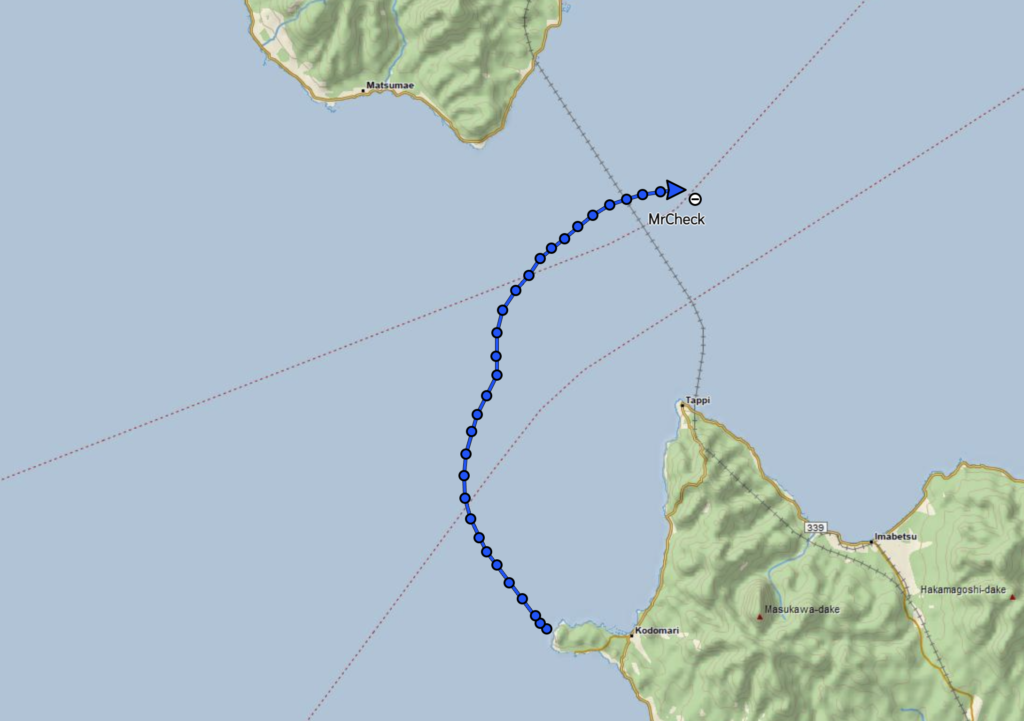
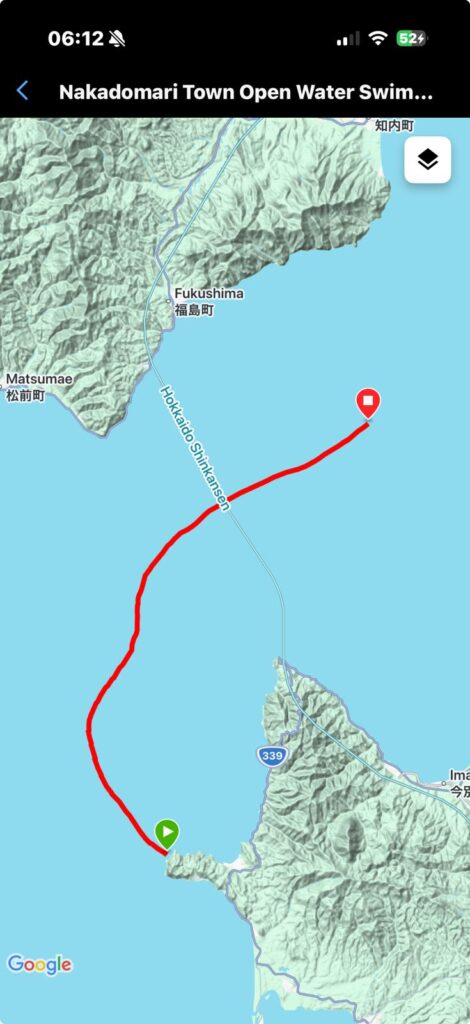
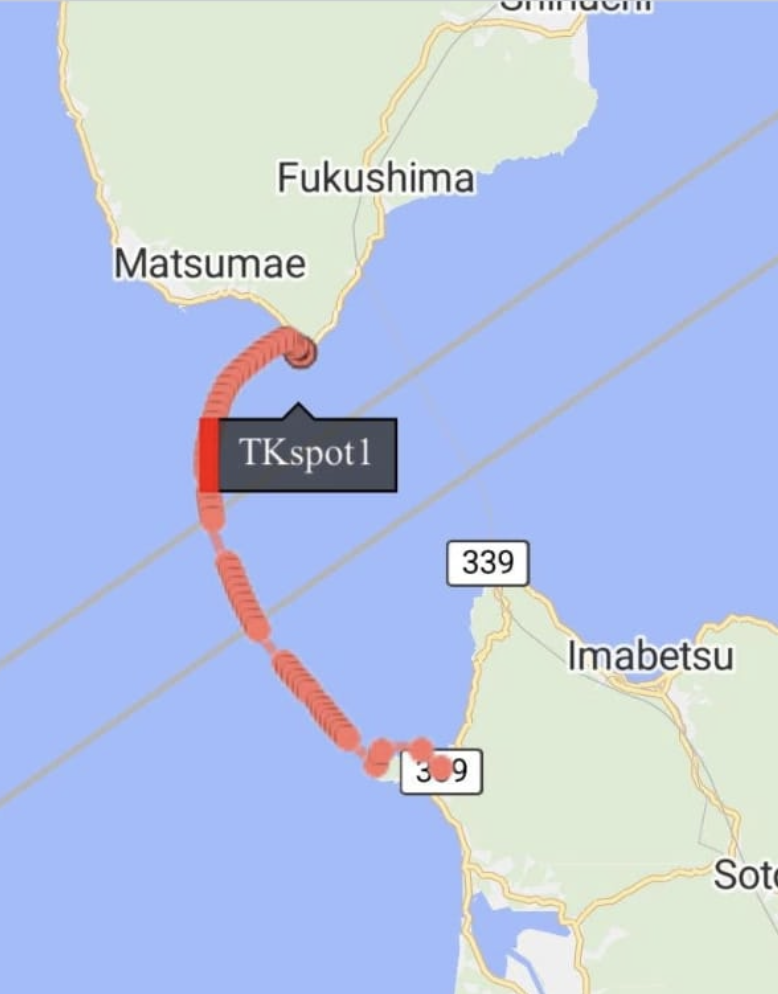
Ezequiel Becerril Zuñiga (47, Mexico, MSF bio here) has completed the 20 Bridges Swim Around Manhattan, the Strait of Gibraltar, the English Channel, the Catalina Channel, the Molokai Channel, and the Cook Strait. Coached by International Marathon Swimming Hall of Fame Honor Swimmer Nora Toledano Cadena and escorted by experienced Captain Hashimoto. While his Tsugaru Channel crossing from Kodomari in Aomori Prefecture to Hokkaido in northern Japan started well enough, once he reached the deepest part of the channel (at 220 meters), the infamous Tsugaru Current was flowing too fast.
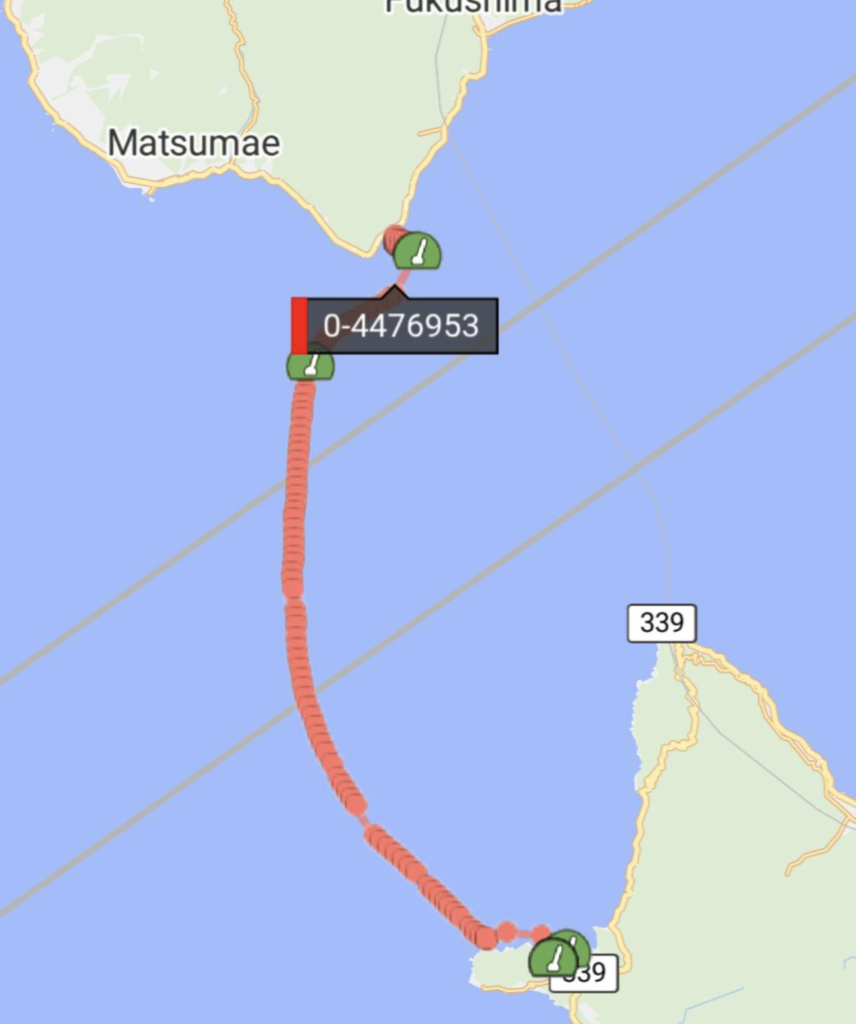
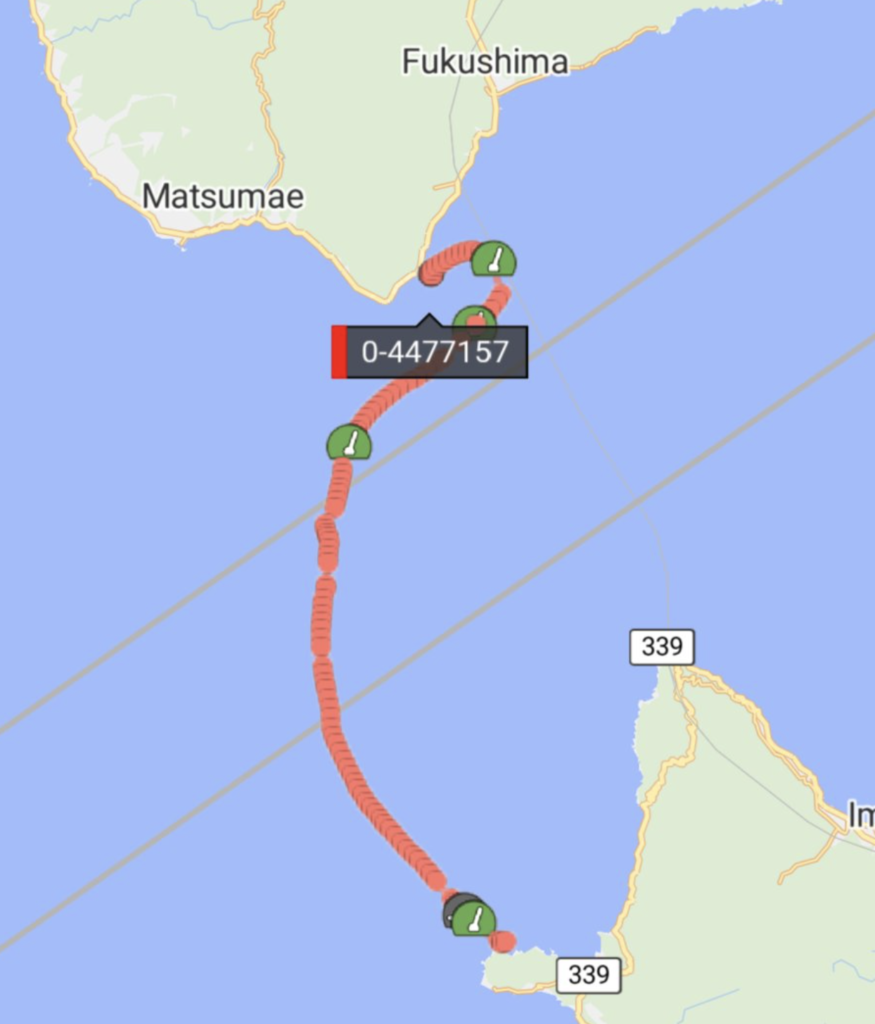
Similarly, Jeff Orenstein (59, USA) has completed crossings of the Catalina Channel, English Channel, Cook Strait, and 20 Bridges Swim Around Manhattan with experienced channel coaches guiding him (Red Top Swim coaches Tim Denyer and Matt Duggan). While his Tsugaru Channel crossing from Kodomari ito Hokkaido also started well enough, once he reached the deepest part of the channel (at 220 meters), the infamous Tsugaru Current was flowing too fast at speeds up to 6.8 knots.
They were both being blown parallel to the Hokkaido shores (Becerril’s course is shown above; Orenstein’s course is shown below).
However, between these two aborted crossings of Becerril and Orenstein, three other channel swimmers from Russia, Switzerland, and Mexico had very different experiences with the Tsugaru Current.
- Andrey Bozhko (39, Russia, MSF bio here, @nemec_mc) had a fast 8 hours 20 minute crossing of the Tsugaru Channel (course shown below on left, 4 years after an aborted crossing of 4 hours 40 minutes).
- Toni Enderli (48, Switzerland, MSF bio here, @tenderliswissprop) crossed in a similar route in 9 hours 40 minutes (course shown below in middle).
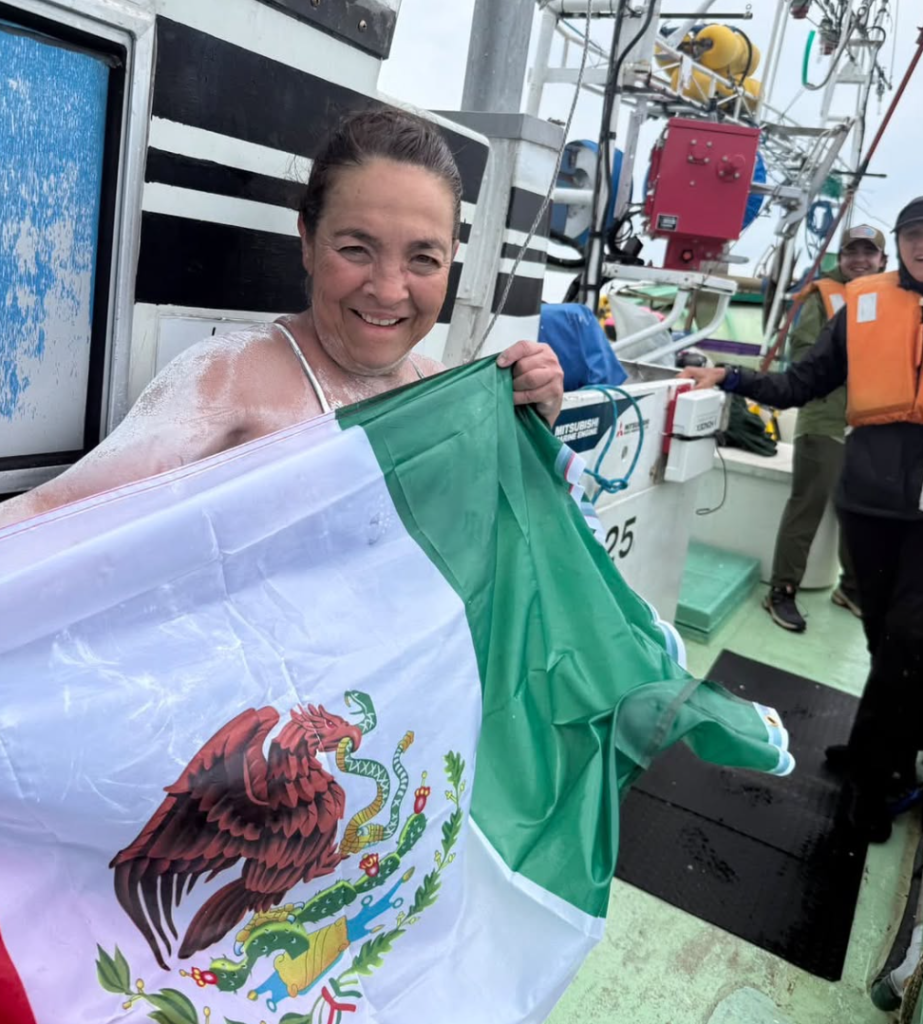
- Sandra Ramírez Vinay (54, Mexico, MSF bio here) tcomplete a crossing in 10 hours 6 minutes (course shown below on right).
The strength and direction of the Tsugaru Current is always an unknown in northern Japan, even for the Japanese fishermen who fish daily throughout the year. While many marathon swimmers look hourly (or very frequently) at Windy and other weather forecast apps, the information provided is simply a forecast.
The forecasts on Windy, for example, are based on global and regional weather forecast models that processes data provided by third-party forecasting agencies that utilize live observational data from weather stations, ground buoys, weather balloons, aircraft, and satellites to calculate wind speed, direction, and gusts.
Currents in Tsugaru are forecast using ocean circulation models, high-frequency radar monitoring, and real-time data collected by ferry-mounted Acoustic Doppler Current Profilers and maritime guidance from the Japanese Coast Guard radar stations located on either side of the channel. The coastal radar stations measure surface current vectors in real time, capturing localized eddies, tidal residual currents, and drastic changes over underwater sills while long-term cross-channel velocity data profiles are gathered continuously via sensors mounted on the various commercial ferryboats that cross the channel on a daily basis.
But the topography of Cape Tappi in Aomori (in the south) and the southwestern coastline of Hokkaido (in the north) can create residual currents that flow up to 0.3 meters per second (see here). For each swimmer who aspires to cross the channel, the Tsugaru Current is the dominant eastward flow that meanders – seemingly randomly – in the summer months.
And the differences in swimmer’s reactions could not be more different.
© 2026 Daily News of Open Water Swimming
“to educate, enthuse, and entertain all those who venture beyond the shoreline“
World Open Water Swimming Federation, a human-powered project.