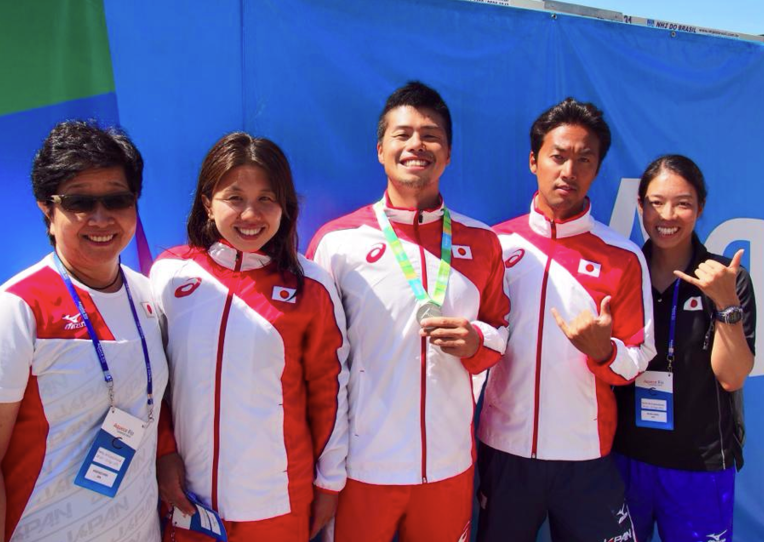
Reira Hara of Nihon University [shown above in a blue shirt with Olympic marathon swimmers Yumi Kida and Yasu Hirai) and her colleagues Yasunori Fujito, Tomomi Fujimoto from Niigata University and Kazuo Funato at Tokyo Metropolitan University published a study in the Journal of Functional Morphology and Kinesiology called “Evaluation of Race Pace Using Critical Swimming Speed During 10 km Open-Water Swimming Competition” [see here].
They looked at estimating the race times in open water races based on the swimmer’s pool swimming times and concluded that such an understanding could be useful for talent identification and training optimization.
They wrote, “We aimed to compare the swimming speeds of the world’s top and other swimmers in the 2023 World Aquatics Championship men’s 10 km race. 65 swimmers were divided into four groups: G1 (that included the fastest 10 swimmers), G2 (swimmers in the 11st–30th positions), G3 (swimmers in the 31st–47th positions), and G4 (swimmers in the 48th–65th positions).”
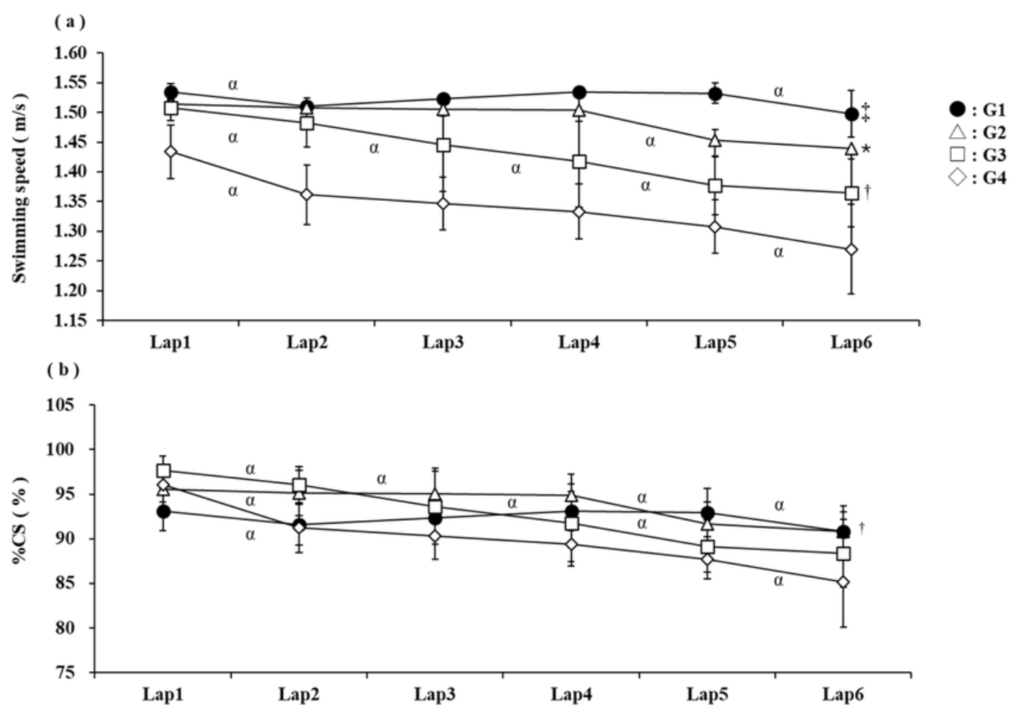
The Japanese researchers analyzed their swimming speed, stroke frequency, and stroke length for each of the 6 lap of the 10 km race. The swimmers’ critical speed was calculated based on each participant’s personal best times in the 400m, 800m, and 1500m freestyle events in the pool. Their swimming speed in the open water was calculated against their critical speed in the pool.
Their results were interesting and logical.
The top performance group (G1) maintained their swimming speed from beginning (lap 1, 1.53 m/s) to end (lap 6, 1.50 m/s). In other words, they got faster as the race developed and swam at 92.7 ± 1.9% of their critical speed in the pool. These top swimmers swam using a longer stroke length (1.26 meters) and lower stroke frequency (72.86 revolutions per minutes). Groups G3 and G4 were unable to maintain their swimming speed, which decreased: G3 was 97.64 ± 1.62% while G4 was 96.10 ± 1.96% of critical speed on lap 1, but fell to G3: 88.39 ± 3.78% and G4: 85.13 ± 5.04% by lap 6. In other words, while the top swimmers got faster, the slower swimmers got slower.
The researchers interpreted the data by observing that the reduction in swimming speed is consistent with the increased reliance on anaerobic metabolism reported in previous studies under similar conditions.
Their conclusion: “Race pacing for maintaining speeds of 92%CS throughout the race could be an important resilient index in open water swimming. Percentage of critical speed might be a useful index for estimating the athletic performance level in open water swimming.”
I can imagine that drafting in a large pack is also assumed to play a role in these differing percentages. The slower swimmers were able to draft closely to the faster swimmers over the first few laps when large packs tend to form, but then gradually the slower swimmers lost contact with the faster swimmers in the lead pack and had to swim without the benefit of swimming in a pack. Simultaneously, the opposite effect may have also been occurring in the lead pack. That is, as the faster swimmers picked up their pace in the second half of the race, the entire lead pack ended up swimming faster in a collective effort.
Ever since we implemented lap (split) timing at the World Open Water Swimming Championships, this second half speed (i.e., faster pace) of the top swimmers has been consistently shown. It has also been shown that the top male swimmers have had a faster negative split – relatively speaking, on average – than the top female swimmers over the years. To look at the data from another perspective, the top female swimmers start their races at a faster pace and hold that same pace consistently throughout the race. In other words, the women start fast and hold their pace, while the men start slower and end faster, in general and in relative terms.
© 2026 Daily News of Open Water Swimming
“to educate, enthuse, and entertain all those who venture beyond the shoreline“
World Open Water Swimming Federation, a human-powered project
New Open Water Swimming Educational and Motivational Course – register here