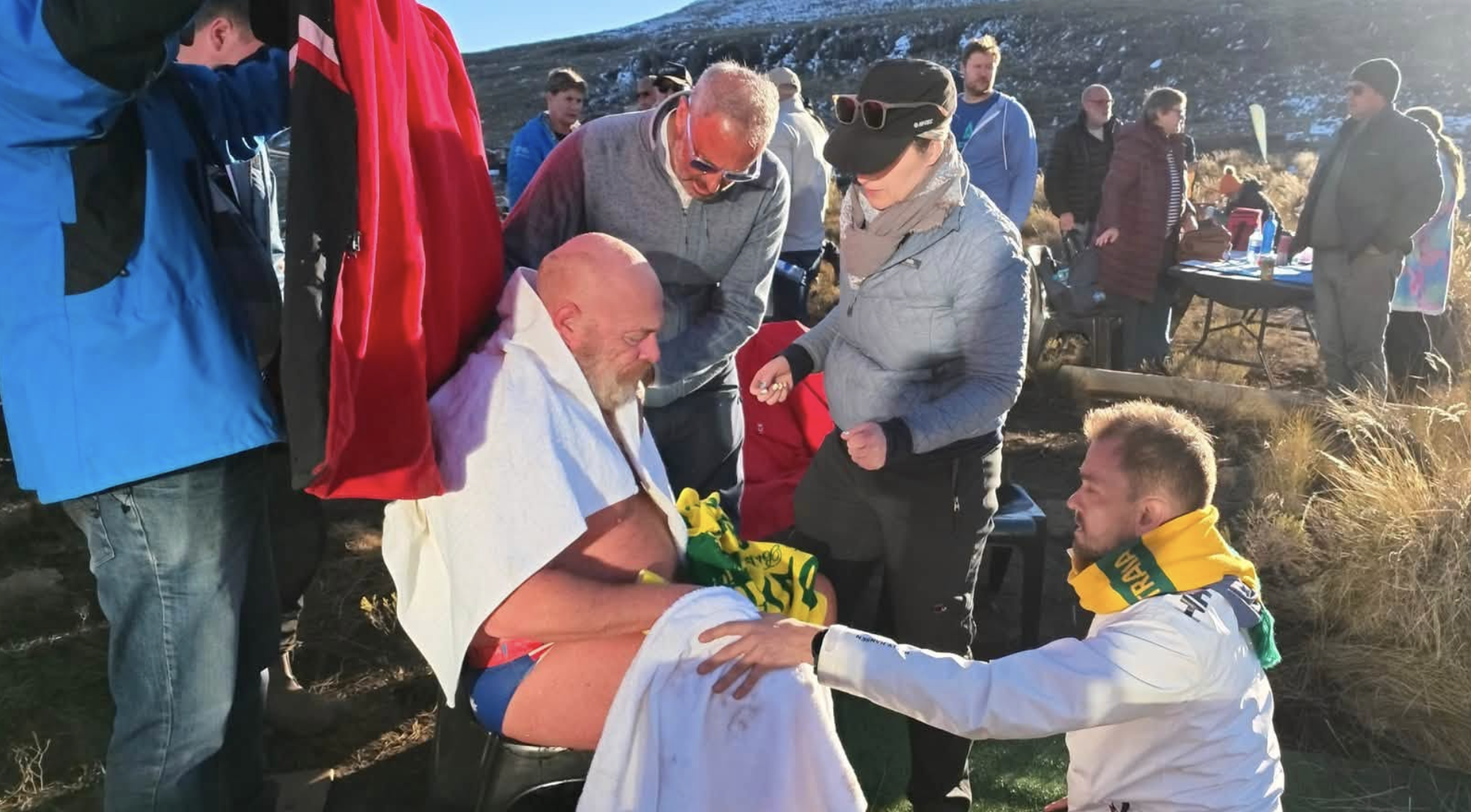
With his ninth career Ice Mile by International Marathon Swimming Hall of Fame Honor Swimmer Lynton Mortenson (Australia, 62, MSF bio here, IISA bio here), it brought to mind the age-old question in the open water: how much is too much?
- Is a swim too far?
- Are the conditions too rough?
- Is the water too cold?
- Is the water too warm?
- Are the number of jellyfish stings too much?
- Is the fog too thick?
- Are the oncoming currents too strong?
- Has the swimmer become too fatigued?
- Is the swimmer increasingly becoming (sea)sick? Are they vomiting?
- Is the swimmer’s training sufficient to finish?
All these questions are difficult to answer. The answers depend on the swimmer and the conditions that they face.
In reality, the decision to carry on lies with the swimmer. Or does it? Or should it?
Can swimmers hide their true physiological state from their coach and support crew? Yes, it happens more often than not.
What happens when the swimmer becomes incapable to objectively judge themselves or their core body temperature? What happens when the swimmer is not aware of the deteriorating conditions, adverse currents, an oncoming storm, or their own inability to make rational decisions? Then, the decision to carry on falls on the second in ice swimming, the coach, observer ,or pilot on a channel crossing, an escort kayaker in a marathon swim.
Over the decades, swimmers have continued to push the limits. When they set records, the pressure for others to extend their own limits becomes greater.
Sarah Thomas has swum 168.3 km over 67 hours 16 minutes in Lake Champlain in 2017 and then swam an unprecedented 134 km four-way crossing of the English Channel in 54 hours 10 minutes in 2019 – both previously unfathomable distances and durations.
The longest ice swim in history was 6.025 km in 4.18°C water in 1 hour 52 minutes by Krzysztof Gajewski of Poland.
The bar keeps on rising and the open water swimming community keeps on responding with greater and greater feats of endurance.
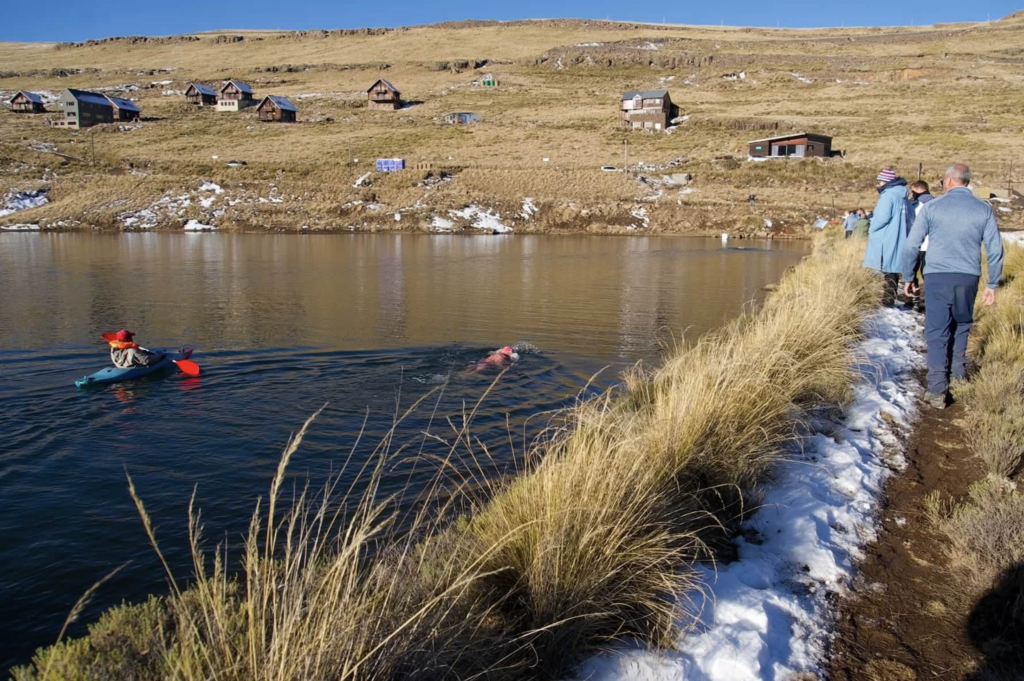
As Mortensen described the lead-up to his ninth Ice Mile, “My 50m test swim two days beforehand was brutal. I felt completely breathless and my hands and feet felt as though I had swum a full ice mile. My 100m event the next day was better, but even after three days of acclimatizing to the altidude I was still puffing after walking up a few stairs. For the first time before a major swim, I found it difficult to convince myself I would finish.
The opening 200m became one of the hardest mental battles I’ve experienced in any swim. I couldn’t breathe or find any rhythm. I felt like a goldfish outside its tank gasping for air. I felt like I was breathing through a straw.
I switched between freestyle, breaststroke and backstroke, trying to find something that worked. At about 100m, I was ready to get out. One voice said, ‘No problem, mate…there’s no shame in stopping.’ The other voice reminded me of our family moto, ‘Never give up – keep swimming until you run out of water’…or in this case ice.
I took on my chameleon mindset – I adapt and blend into my environment.I became one with my environment. I had to stop fighting the mountain and embrace it.
Sam Whelpton and I discussed and knew the first 400 meters would be hell. We just had to get to 400 meters to find a rhythm, a calmness breathing, getting comfortable being uncomfortable & giving determination and grit a chance to take over. I remember locking eyes with Lisa and Sam on the shoreline and thinking just make it to 400.
Lisa, Laurence and Ram followed along the bank as the whole shoreline seemed to carry Marcelle and me forward. At around 200m something finally clicked….my breathing settled, freestyle returned and I found a rhythm.“
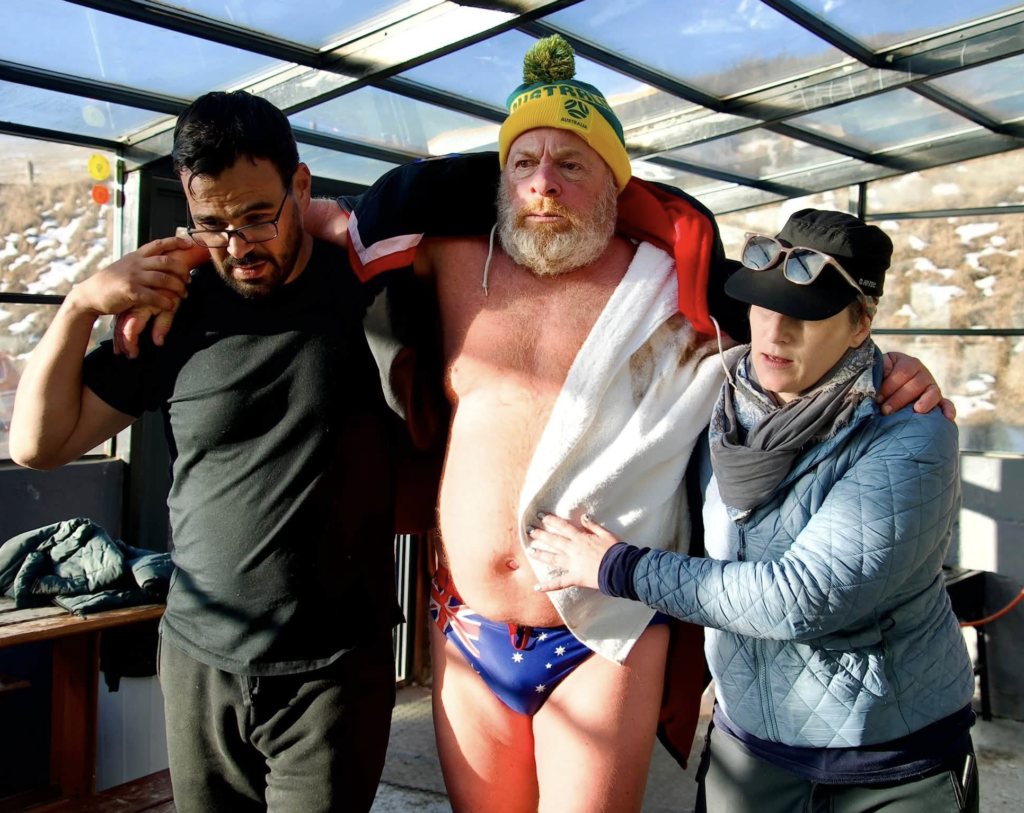
May everyone find their rhythm.
© 2026 Daily News of Open Water Swimming
“to educate, enthuse, and entertain all those who venture beyond the shoreline“
World Open Water Swimming Federation, an exclusively human-powered project.