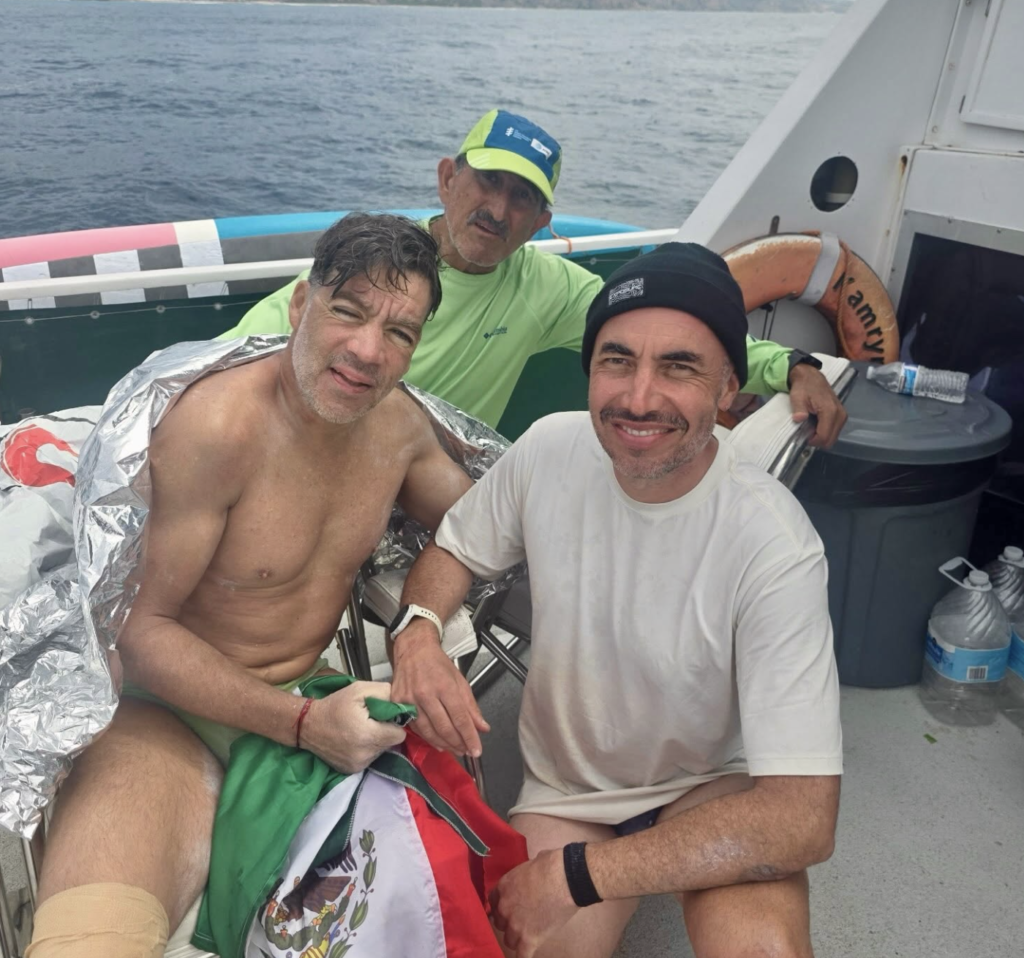
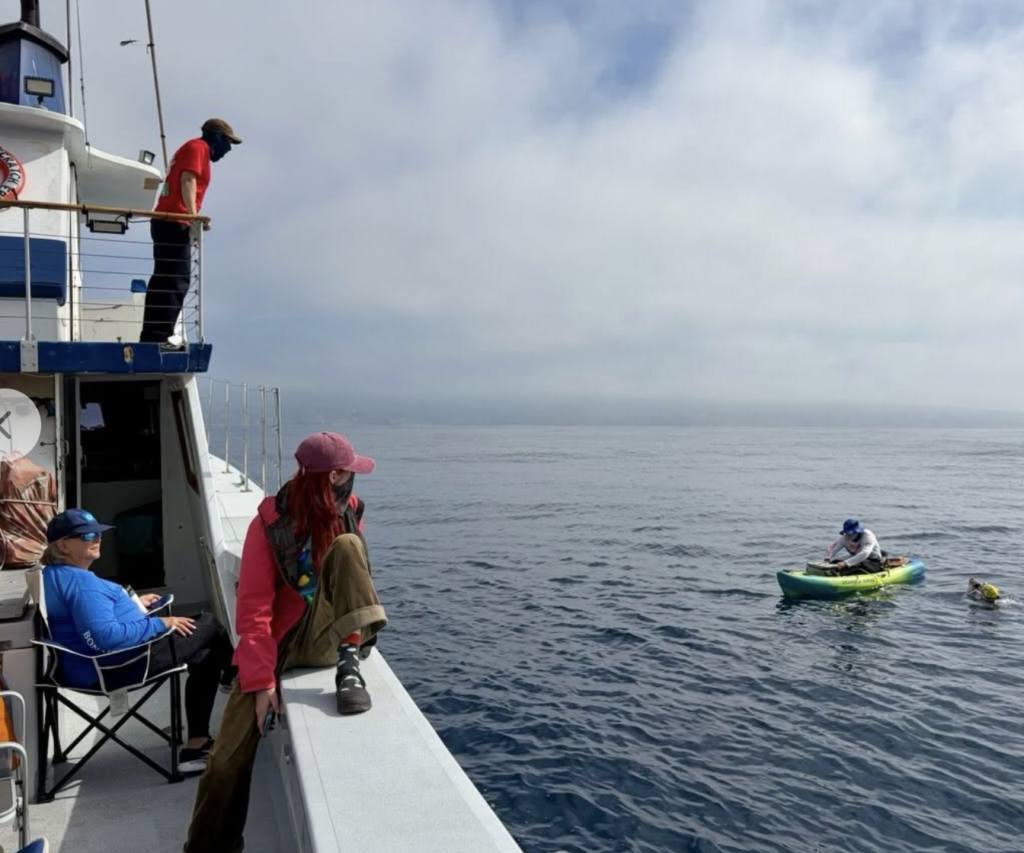
Carlos Acosta Aldrete (53, Mexico, MSF bio here) has already achieved the Triple Crown of Open Water Swimming, but is going for more.
English Channel
In 2016, he completed a 33.5 km crossing of the English Channel from England to France in 15 hours 31 minutes at the age of 43. Four years later, he attempted a two-way crossing of the English Channel that was aborted after 9 hours 9 minutes. But then he came back in 2023 to complete a 67 km two-way crossing in 28 hours 16 minutes. His first leg from England to France took 11 hours 58 minutes; his return leg from France to England to 16 hours 18 minutes.
Catalina Channel
In 2017, Acosta completed a 32.3 km crossing of the Catalina Channel from Santa Catalina Island to the Southern California mainland in 11 hours 22 minutes. This week, he really stepped up his game and completed a 64.6 km two-way crossing of the Catalina Channel in 38 hours 7 minutes. His coach Jorge Villegas (an International Marathon Swimming Hall of Fame Honor Coach, Class of 2025) and crew chief Rodrigo Alegre and observers Joel Virgil and Steve Chase were onboard his escort boat.
The Catalina Channel Swimming Federation reported, “Carlos persevered through a long and arduous 38-hour swim, taking on a Catalina Channel that was still feeling the effects of Hurricane Marie. Through the long hours and changing ocean, he continued moving forward to complete the two way crossing.
Described as someone with a big heart who is always helping people and animals, Carlos used his swim to raise awareness for shelter animals and their care, adding special purpose to an extraordinary endurance challenge.“
Q&A
Q1. In one of the photos, it looks like you have a bandage on your right knee? Did you cut yourself or get injured during the two-way crossing?
A1. Yes, I got injured at the finish. We arrived at Terranea Beach, which has large rocks, and while I was trying to find my balance to stand up, a wave pushed me and I crashed against the rocks. We had to land on that beach instead of Smugglers Cove, where we started, because we were fighting strong head currents, and reaching the other cove would have taken us roughly an extra hour and a half.
Q2. After you continued swimming for 28-30 hours on your return trip, what were you thinking?
A2. When I reached the island and my Coach Coco told me the first leg took over 17 hours, my first thought was what the captain had mentioned earlier: the return trip would be easier. So, I figured the way back might take 14 or 15 hours. As we progressed, I used the sun as my clock. When night fell, I tried keeping track of my feeds to guess the time. I thought we would finish early into the second night.
At some point in the dark, I asked my crew if we were past the halfway mark of the return leg. They gave me a vague answer, and I knew we weren’t. I calculated it was nearing midnight and realized we still had many hours left. It was a tough mental shift.
I had to let go of the idea that the end was near and accept that I was going to be in the water for as long as it took. My original estimate for the two-way was 22 to 26 hours; understanding it would take over 35 was a heavy blow. I disconnected my mind from my body and just let myself go, swimming almost without limit, as long as I could still move my arms. When the sun came up and I realized we still had more than 4 hours left, it was another harsh reality check, but my mind was already in a different dimension.
I had to dig deep for every possible reason to stay in there and not quit. I kept reminding myself over and over that I wasn’t going to break, that my arm wasn’t going to fall off, and that sooner or later, we would arrive. During that second night, I am sure there were moments where I fell asleep for stretches of 2 or 3 strokes. I talked to Neptune and Yemaya, asking why they had given me such a difficult test. I realized that the ocean is simply the ocean; the currents weren’t bothering the marine life. The one on a personal challenge, trying to conquer himself and claim his freedom, was me.
Q3. Did you start on Terranea where you finished? Or did you start in another place? Where did you land on Catalina Island?
We started at Smuggler’s Cove, but we finished at Terranea due to the currents. My crew told me later that the captain spent a long time scanning the coast with his binoculars before making the final call on where we would land. On Catalina Island, I landed at Doctor’s Cove.
Q4. What was the difference between your two-way crossing of the English Channel and this Catalina Channel two-way crossing?
A4. The difference was massive. For the English Channel, I estimated 30 hours and finished in 28. The first leg was very fast (11 hours 58 minutes), which gave me a huge morale boost on the French shore for the return. The way back was much harder due to currents and tides, and the last four hours were heart-stopping. However, I expected the Catalina two-way to be easier, and it turned out to be brutally difficult on both legs.
Lesson learned: never, ever underestimate a swim. The ocean can present unimaginable challenges at any given moment.
Q5. Did you eat and drink the same things in the both English Channel and Catalina Channel?
A5. The feeding plan was very similar. For the English Channel, I alternated between Swer Energy mix and Gu Roctane—every 40 minutes on the first leg, and every 30 minutes on the second, plus BCAAs every 4 hours and canned peaches every 3 hours.
For the Catalina Channel, it was almost the same, but I used Maurten 320 instead of Swer Energy mix. However, around hour 25 or 30, the Hibiscus-flavored Gu Roctane started giving me severe heartburn, so I asked my crew to stick exclusively to Maurten.
Q6. Did you train the same way for both channels – or was your training any different?
A6. My training was drastically different and significantly lower in volume for Catalina compared to the two-way English Channel. I had two bicycle accidents, one in April 2025 and another in February 2026, that kept me out of the water for several weeks each time due to left shoulder injuries. I arrived at the start line without having completed all the planned long swims or total distance. After being forced to stop twice for over a month, I had to rebuild my volume very carefully to protect my recovering tendons. The numbers tell the story:
- For my two-way English Channel (September 2022 – September 2023), my total volume for the preceding year was 1,521.5 km over 445 hours.
- For Catalina (September 2025 – September 2026), it was 946.4 km over 276 hours. I arrived with 38% less volume (575 km and 169 hours less).
I had to rely on muscle memory, past experience, and the absolute certainty of knowing what it feels like to swim for 28 hours.
This experience confirmed something I’ve heard many times: a crossing like this is 50% physical and 50% mental. If it relied solely on the physical aspect, I wouldn’t have made it.
During the swim, I kept recalling concepts from books like Ross Edgley’s The Art of Resilience, Lionel Terray’s Les conquérants de l’inutile, and Peak Performance by Stulberg and Magness; in which I learned of the Navy SEAL 40% rule: when you feel absolutely done, you are only at 40% of your capacity. That our bodies are far stronger than our protective, hypochondriac minds let them be.
Eventually I concluded that if my body truly failed, the swim would end without my input; my crew would pull me out. But making a conscious decision to quit meant the mind had won. I kept thinking on Terray’s concept: that the true value is not in the title or the utility of the act, but in the victory over your own doubts. I played mind games that would keep me going when reason told me to quit.
I recently read a quote by Robert Brault: “How often in life we complete a task that was beyond the capability of the person we were when we started it?” I think it applies 100% here.
Q7. What were the water conditions in Catalina?
A7. Surface conditions were relatively good, though quite choppy at times. The real issue was the relentless head currents. You don’t physically feel a head current when you are swimming, but I was told later that there were periods where my stroke rate was normal and we were barely advancing. We had them on the way there and on the way back.
Q8. Did you see any marine life or bioluminescence during the night?
A8. I didn’t see any marine life aside from one tiny fish. The bioluminescence was also very minimal. It wasn’t as incredible as I remember from my 2017 crossing; I only saw a few glowing bubbles, but none of the impressive glowing streaks I had seen before.
Q9. It appears that you had some family members and friends at the finish in Terranea, who were they? How long were they waiting for you at the finish?
A9. It looks like it in the videos, but no. They were actually just people who happened to be at the beach. When they saw us arriving and found out where we had swam from, they became very interested and started asking questions. My partner, Rodrigo, shared my Instagram account with them, and it was great because they even wrote to me later to congratulate me.
Q10. Why are you driven to swim two-way crossings of the English Channel and Catalina Channel? You know these swims will be very difficult, but you still try. Why?
A10. When I proposed crossing the English Channel in 2012, I had no idea what I was getting into. I had barely done any sports in my life and had smoked for many years. When I quit smoking in 2011, I realized that if I could do something that difficult, I had just unlocked the possibility of doing much harder things. I started with a sprint triathlon and immediately fell in love with the nerves, the challenge, and the joy of finishing.
Around that time, I heard about someone who had crossed the English Channel (fellow Mexican swimmer Samuel Neri). When they told me he wasn’t a lifelong athlete or a gifted swimmer, something shifted in my mind. I saw an incredible challenge that maybe I could achieve too. That seed grew, and after a bike accident kept me out of triathlons for a few months, I decided that once I recovered, I would swim the English Channel.
In 2012, I started training with Nora Toledano, who coached me until 2019. I discovered a whole new world, a community of swimmers and other amazing swims besides the famous English Channel. In 2016, I successfully crossed the Channel in 15 hours and 31 minutes. It marked me deeply; I achieved something I didn’t even know was possible for someone like me just a few years prior.
I went on to complete the Triple Crown, swimming Catalina in 2017 and 20 Bridges in 2018. But even though I was happy to finish, something wasn’t right. I didn’t feel that same intense mix of fear and challenge. I realized I needed something really big to feel that spark that made me feel truly alive in 2016; so I envisioned the 2-way English Channel swim. A mammoth swim that made me nervous and fearful again.
My first attempt in 2020 was unsuccessful. A mix of harsh conditions, an unknown caffeine overdose, and a strong physical hit at the start caused my heart rate to spike dangerously, ending my swim at hour 9. It took me months to mentally recover from that failure and find the courage to try again. In the meantime, I became an Ironman and had the opportunity to do a pioneer 46 km jungle swim from Bacalar to Chetumal in Mexico.
When I finally returned and succeeded in the two-way English Channel in 2023, I was meticulous with every detail. It made me feel alive again. It took me months to process such a long swim and also made me understand something that long is so difficult and taxing, that it is not something I would do again soon. By the end of 2024 I was ready for another massive challenge and chose another brutal double: Catalina. However, I never expected the conditions to challenge me even more than the English Channel.
I haven’t fully processed everything that happened yet. I swam for much longer than I could have ever imagined. I’ve learned that science has shown that in non-life-or-death situations, our minds quit long before our bodies break and that our bodies are much stronger than our protective, hypochondriac minds let them be. So during the swim I concluded that if my body truly failed, the swim would end without my input; my crew would pull me out. But if I made a conscious decision to stop, my ‘conservative’ mind would have won.
Remembering what I’ve learned about pushing limits, I knew I had the perfect opportunity in front of me. My original plan was 22 to 26 hours. Since there was no immediate risk of death despite the difficult conditions, I found myself in a very special moment of freedom: I had to decide whether to swim the twenty-something hours I had planned and stop because “the conditions weren’t right,” or decide to swim the Catalina two-way, regardless of the conditions.
It seems like a subtle difference, but it is enormous.
If I had to explain this to a child, I would tell them that to do something like this (or for any difficult things in life), you have to prepare for a long time, training both your body and your mind. Sometimes training is hard, and you get tired of doing the same thing every day, but having a clear goal keeps you going. When you are out there in the ocean for hours, your body gets tired, and that’s when your mind has to take over. I would also tell them that not finishing a challenge isn’t a failure—the only true failure is not trying at all.
People often ask if I get scared swimming in the ocean at night. Of course I do! I have a lot of fears: the dark water, the cold, the jellyfish, or simply not finishing. But just like when we are kids and we are afraid of the dark or the monster in the closet, we eventually realize those monsters only exist in our minds. The things that scare us the most aren’t usually out there; they are inside our heads.
I don’t try to avoid fear; instead, I like to look fear right in the eyes to understand it. Sometimes fear is actually helpful because it warns us to be careful and prepare properly. But fear is a terrible advisor if you let it make your decisions. If you let fear win and control you, you will miss out on some of the most amazing things in life. I do these swims to prove that you shouldn’t let fear stop you from discovering what you are truly capable of.
© 2026 Daily News of Open Water Swimming
“to educate, enthuse, and entertain all those who venture beyond the shoreline“
World Open Water Swimming Federation, an exclusively human-powered project.