

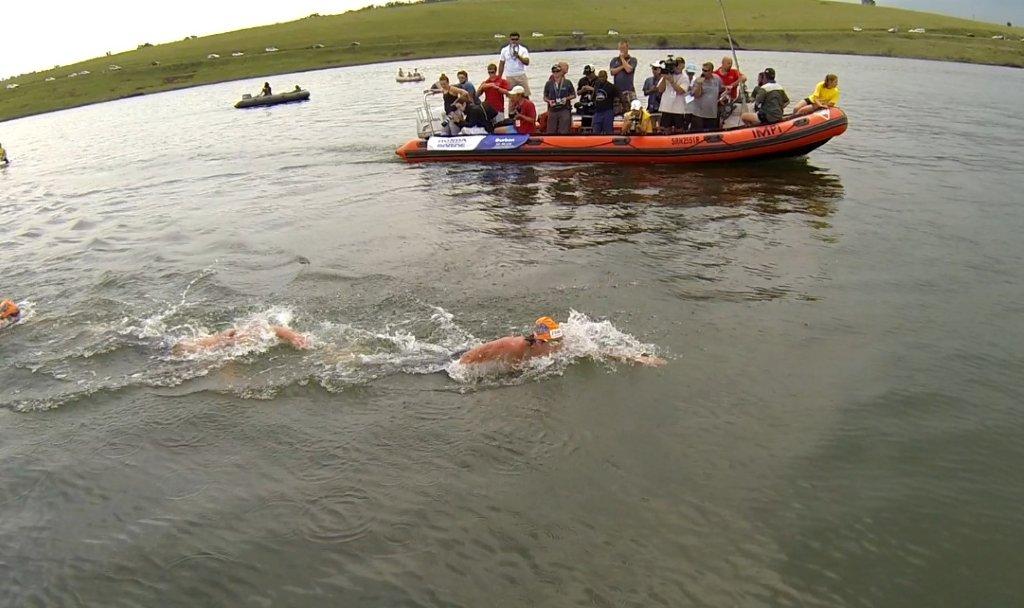

 One of the coolest phenomena at the world’s largest open water swimming competition at the Midmar Mile in Pietermaritzburg, South Africa is the use of the RC Helicam Quadcopter.
The battery-powered, remote-controlled Quadcopter can be launched from anywhere at the venue. At the 2013 Midmar Mile, owner-inventor Andrew Martens took the Quadcopter on the media boat and was able to capture outstanding images of the leaders and the field from above throughout the race.
The use of the aerial footage in competitive races is potentially a game changer. Instead of officials being out of position on an escort boat or guessing what happens between athletes in a pack, the officials can now be in ideal position with an optimal perspective. Through the images taken by the camera on the Quadcopter, they can easily make objective judgment calls during a race. Usually, officials only have one perspective of the swimmers from the side of a boat. With the Quadcopter, officials can now enjoy viewing the athletes from above or any position, giving them optimal aerial perspectives. The officials can now see the action much better and objectively witness if the athletes are impeding other athletes, veering into other swimmers, touching their legs or feet, or throwing an elbow.
Furthermore, because the athletes will know they are being potentially watched from the RC Helicam’s “eye in the sky”, they are less likely to push or violate the rules. This new and clear perspective by the officials will effectively reduce the physicality of the elite and professional competitions.
We believe this new technology will lead to positive changes for both officials and athletes.
Undoubtedly, the images (both still and video) that can be captured by RC Helicam’s Quadcopter are unique and beautiful. The images can present the sport and the athletes in rare and interesting perspectives. These images can then be used for promotional and advertising purposes by the event organizers, sponsors, the media and the athletes.
The Quadcopter can also quickly cover a wide area.
From the race director’s perspective, the Quadcopter can verify if the buoys are lined up properly. From a Safety Official’s perspective, the Quadcopter can identify if there any hazards or stray swimmers to worry about. From an athlete’s perspective, the Quadcopter can showcase the water conditions far from shore. From a coach’s perspective, the Quadcoper can show the line that their athletes swam and how they positioned themselves in the pack during the race. These videos can then be posted online and on the event’s website for public awareness and education.
We strongly encourage FINA officials on the FINA Open Water Swimming Grand Prix and FINA 10K Marathon Swimming World Cup circuits to consider utilizing this innovative technology. RC Helicam has come up with a game-changing technology.
We wholeheartedly encourage use of this technology by NBC television and the IOC for the Olympic 10K Marathon Swim qualifying races and at the marathon swim at Copacabana Beach at the 2016 Rio Olympic Games.
FINA, NBC, and the IOC have the budgets to utilize this reasonably priced, proven, game-changing technology. It is within their grasp and would fit well with their media strategies to promote swimming in this era of social media. But until FINA, NBC and the IOC makes a decision on this technology, we will continue to see the amateur open water swimming market continue to utilize creative technologies and innovations. The grassroots level will bring the sport closer to fans and the media.
And the RC Helicam’s eye-in-the-sky will continue to be used at leading events like the Midmar Mile. These amateur mass participation events will push the envelope and make the sport more visually entertaining to its participants and the general public.
The images shown in this article from RC Helicam show winner Chad Ho leading Troy Prinsloo and the other top competitors.
Copyright © 2013 by Open Water Source