
I was asked If training in San Francisco Bay for a crossing of the Tsugaru Channel in northern Japan was ideal.
Training in San Francisco Bay (specifically Aquatic Park) is good without a doubt. Swimming around Aquatic Park year-round will certainly prepare you well for the possible cold water conditions of the Tsugaru Channel.
But from a different perspective, Tsugaru challenges swimmers in more profound ways rather just cold water acclimatization:
- Swimming against very strong currents
- Swimming amid very high winds
- Facing oncoming waves and up and down ever-changing ocean swells
- Dealing with cold water (or warm water, depending on the specific day)
These conditions are listed in a specific order. That is, strong currents is the most challenging issue in my experience and observation over 40 years. High winds are the second most challenging issue. Oncoming waves and ocean swells is also a tough issue. While cold water (or warm water) is down at #4.
Most Tsugaru Channel swimmers are well prepared to handle the cold water (or warm water). But in my observation, many Tsugaru Channel swimmers are not well prepared to handle the strong, ever-changing currents and rough water conditions between the islands of Honshu and Hokkaido.
If a swimmer is very lucky – and this occasionally happens – the conditions are nice, warm, flat, and calm. These kinds of conditions are, undeniably, wonderful. These conditions do happen, but no one can accurately predict these conditions, despite whatever the Windy app predicts. Conditions in the Tsugaru Channel can be calm and warm during the first half of the swim – and then can become very rough and cold during the second half of the swim.
A few cases are illustrative of this phenomenon. Perhaps the greatest marathon swimmer of all time – Petar Stoychev of Bulgaria – took 3 hours to swim halfway across the Tsugaru Channel – and then it took him more than 6 hours to finish the second half of the channel, even though he was swimming faster. Olympic medalist and Oceans Seven swimmer Rob Woodhouse had a similar experience.
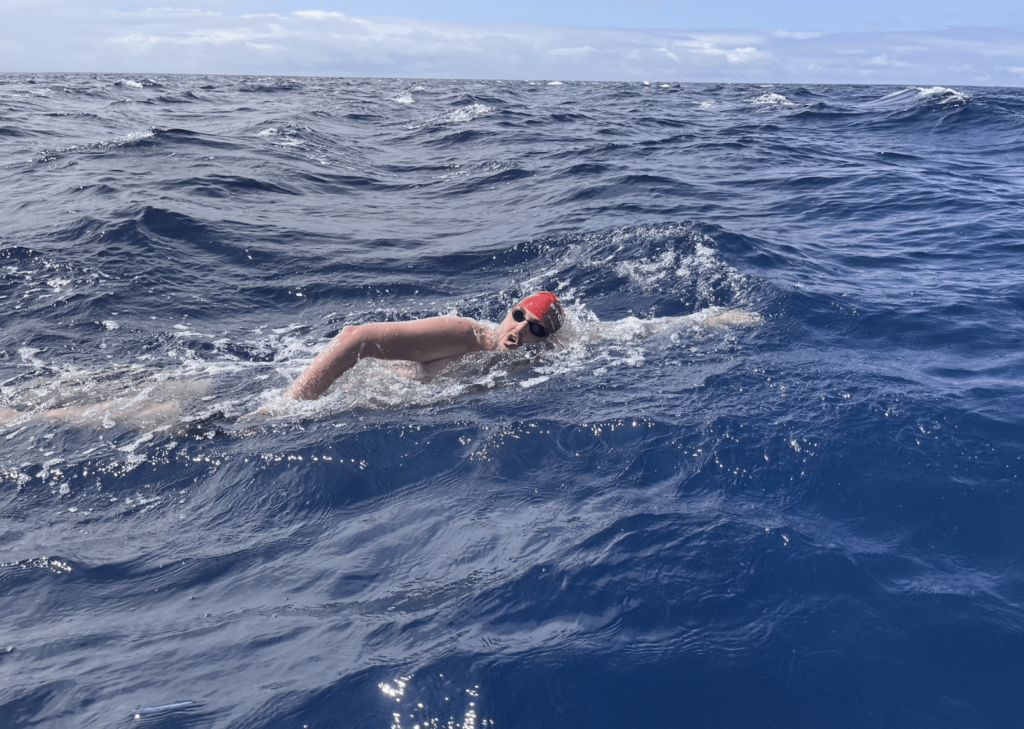

So, swimmers can either (1) depend on luck and hope they swim in calm, flat conditions from start to finish, or (2) prepare for difficult conditions that can be expected most of the time.
I always recommend and chose the second option.
For #2, I can think of no better place to train for the Tsugaru Channel than Huntington Beach in Orange County in Southern California. In Huntington Beach, there are almost always very wavy, rough water conditions [see photo above]. The currents are usually strong and training is not easy. There are similar places along the California coast, but Huntington Beach – known as Surf City USA – is renowned for tough conditions almost every single day of the year, especially if you swim along the coast between 1 pm – 6 pm when the afternoon winds really whip up the Pacific Ocean.
Swimming along the surf line or within the surf zone is, literally, ideal for dealing with and getting optimal experience for the bumpy swim in northern Japan.

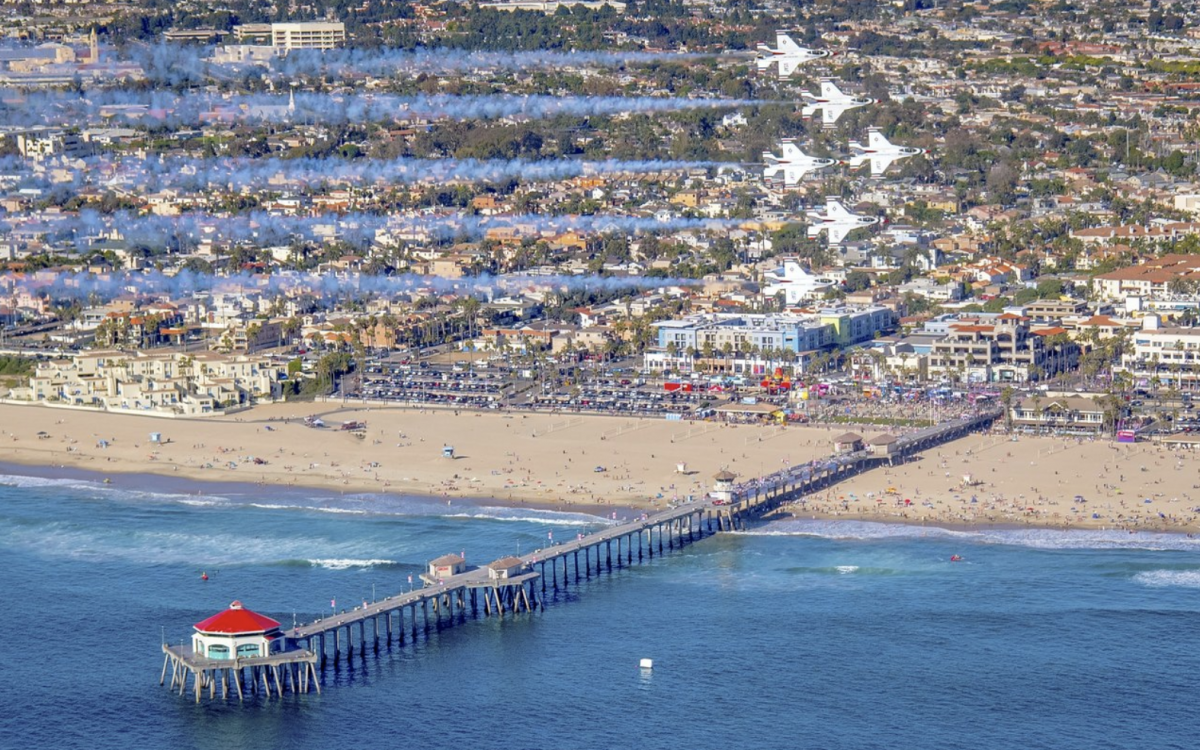
Huntington Beach is located 56 km south of downtown Los Angeles, 59 km south of LAX Airport, and 48 km south of San Pedro. It is one of the major coastline communities of Orange County with nearly 200,000 residents, a long pier that anchors a lively Main Street with many eating options, outdoor shopping malls, both high-end and budget hotels, and restaurants to fit every taste It has 15.3 km of sandy swimmable beaches, a year-round mild climate, excellent surfing and ocean coastline swimming areas, and an extremely vibrant surfing and beach culture.

There are four beaches to do safe, point-to-point or out-and-back coastal swimming in Huntington Beach within view of lifeguard stations, ample parking, and restrooms and showers.
- Huntington State Beach, south of the pier, bordering Newport Beach
- Huntington City Beach, north of the pier, bordering Bolsa Chica State Beach
- Bolsa Chica State Beach, north of Huntington City Beach, bordering Sunset Beach (shown above)
- Sunset Beach, north of Bolsa Chica State Beach, bordering Seal Beach (shown below)

I swim nearly daily at one of the four beaches where for over 40 years I have left my belongings on the beach without fear of theft, although admittedly I leave my wallet at home or in the car. The beaches also offers barbeque pits that are often full for afternoon and evening meals with family and friends. There is also a long boardwalk from end-to-end where many people walk, jog, skate, and ride bicycles (more e-bikes than regular bikes nowadays) from early morning to evening.

Huntington Beach often has surf that can get quite big. If you swim parallel to shore, you can breathe towards the sandy beach on one side and Catalina Island on the other. For channel swimmers, it is a great place to visualize a successful crossing. It is also great for rough water swimming to get used to the ocean swells, waves and wind – especially in the afternoon hours.
While there are only a small handful of locals who regularly swim in Huntington Beach, the local Huntington Beach Pier Swim has been held over 70 years and there is rarely a day when the surfers are not out from early morning to sunset. It is ideal to swim along the coast just outside the surf zone, in full view of surfers and lifeguards posted every 250 meters or so.

The Huntington Beach Pier Swim is an annual sprint around the Huntington Beach Pier. It has been won by national champions, world championship athletes and medalists, Olympic swimmers (Tom Shields on right), NCAA champion swimmers, and Catalina Channel record holders (Hank Wise).


There are also several competitive swimming pools between Huntington Beach and San Pedro where you can swim for hours on end for US$3 – $4 per swim. One of them is the Belmont Pool in Long Beach, a 50m pool that is literally right on the beach.
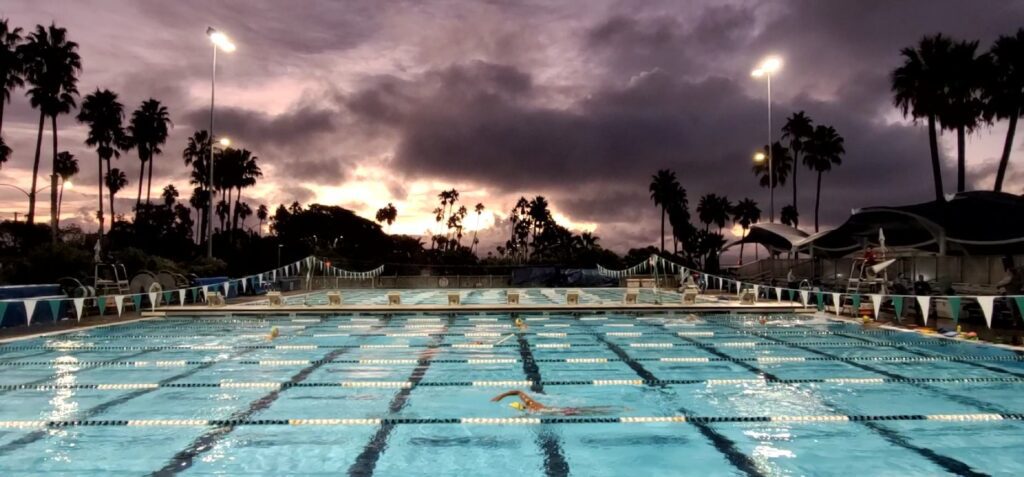
When you are not prepping for your channel crossing and not swimming in the Pacific Ocean, you can also enjoy a lively Main Street and people watching – and there are many real characters who reside in the area – as well as stock up on California lifestyle and beach apparel. There is also a plaques that line the sidewalks with background of famous surfers and watermen and water women as well as the International Surfing Museum.

Both high-end and inexpensive hotels line the coastline and major boulevards of Huntington Beach that can match every budget.


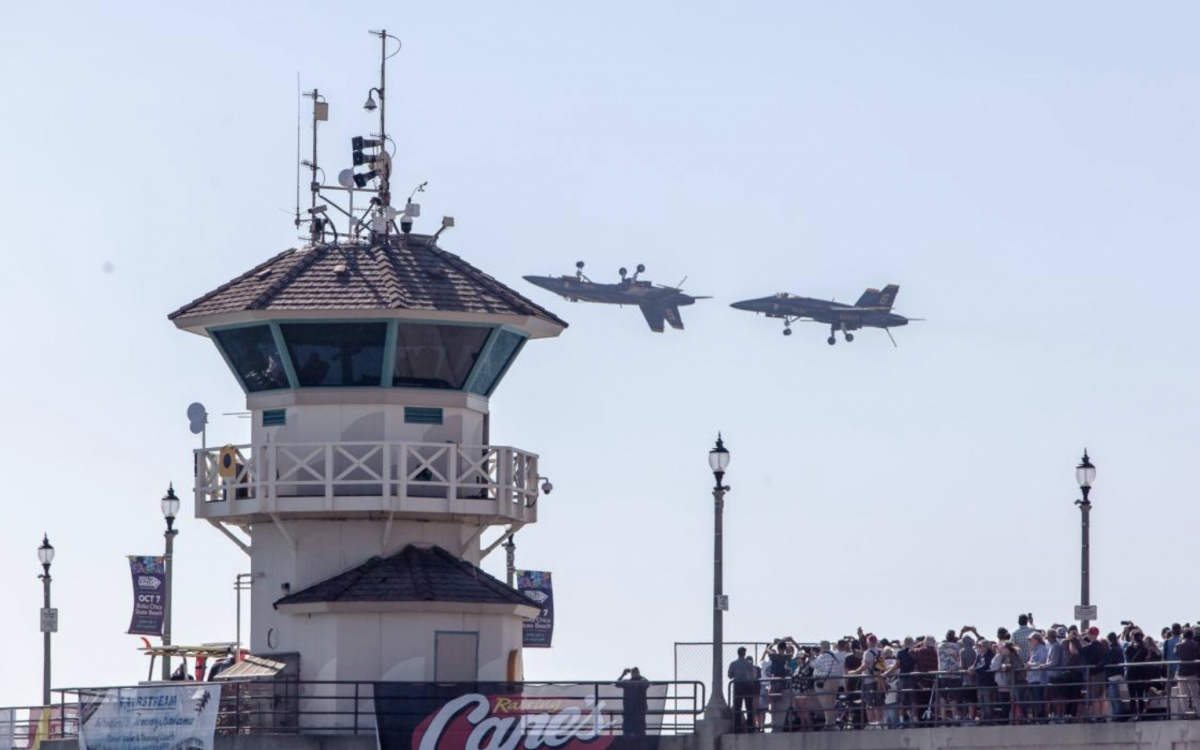
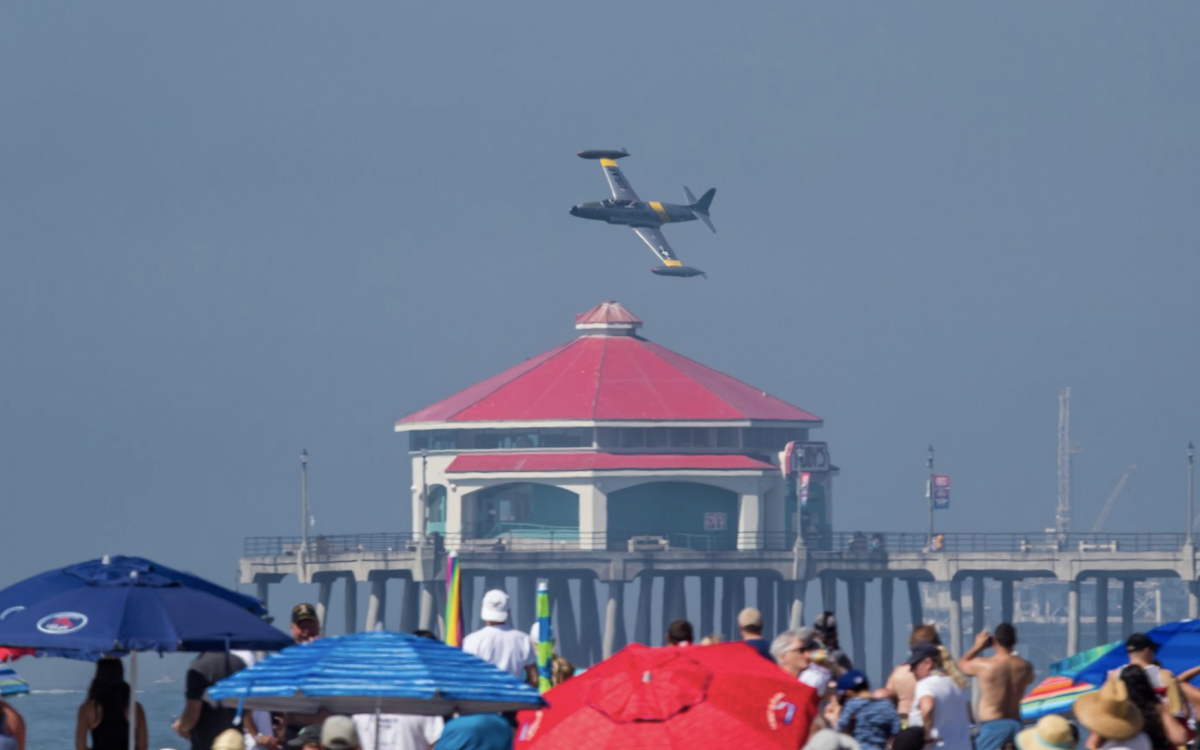
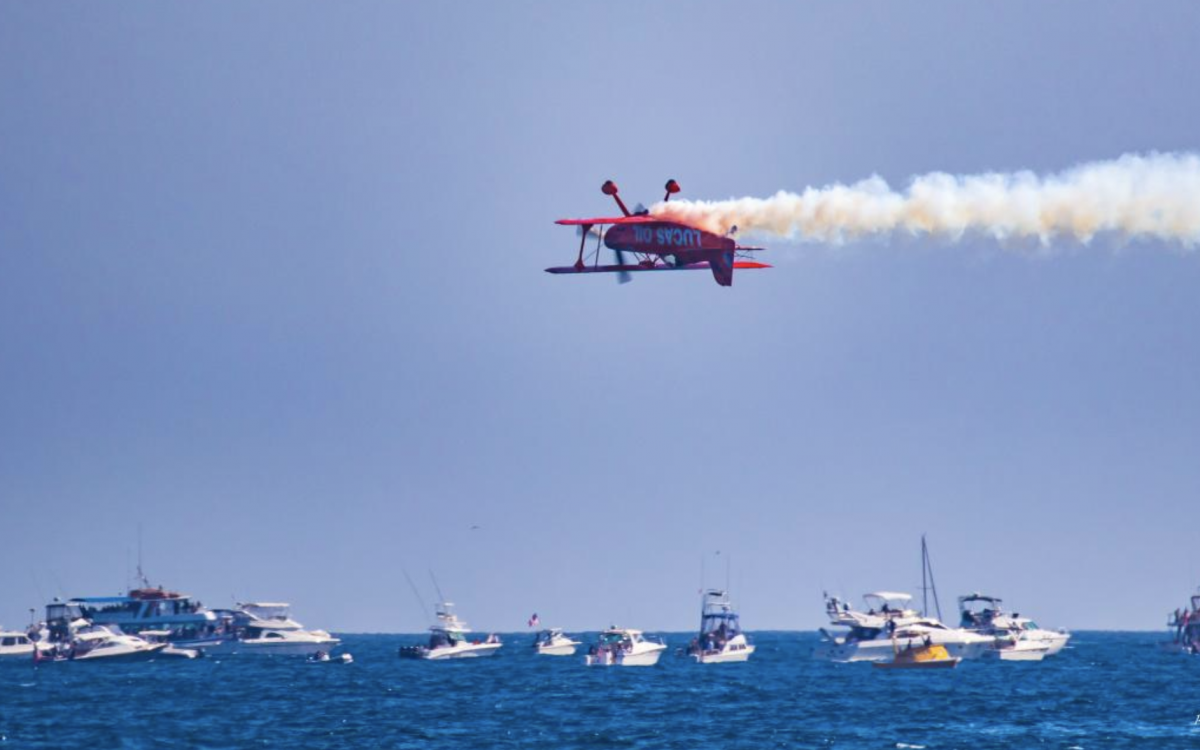
Activities abound during the summer, from the largest surf contests in the Americas and canine surf contests and music concerts to the Pacific Airshow.
If you time your visit during the Pacific Airshow, you can swim as the skies above are filled with the U.S. Blue Angels, Canadian Forces Snowbirds, U.S. Air Force ACC F-35A Demo Team, U.S. Air Force Heritage Flight, U.S. Marine Corps MV-22 Osprey Demo Team, U.S. Navy EA-18G Growler Legacy Flight Team, U.S. Navy F-35C Demo Team, U.S. Navy Leap Frogs, U.S. Army Golden Knights, Jeff Boerboon (YAK 110), Lyon Air Museum, Greg Colyer, Red Bull Air Force, Rob Holland, Michael Goulian, Orbis Flying Eye Hospital, Michael Wiskus (Lucas Oil), FedEx, and O.C. Fire Authority as hundreds of thousands of spectators watch.
For your family and friends who do not swim, there is plenty of walking, jogging, and cycling paths available including Huntington Dog Central Park, the boardwalk along Pacific Coast Highway, and the Bolsa Chica Ecological Reserve (see above). There are also bonfire butlers for either romantic or casual meals on the beach.


But at the end of the day, you are in Huntington Beach to train, to prepare, and to swim in the Pacific Ocean, a grand ocean swimming playground.

Open water swims can be easily and conveniently done along any location in Huntington Beach. The formula is simple: drive or walk to the beach, stretch, check out the water conditions swim, shower, and return to your hotel or AirBnB. Lifeguard towers are visible from the ocean and are evenly spread along the beach.
Swimming straight is easy if you swim just outside the surfers and wave breaks.
Water temperatures are ideal year-round to prepare for channel and marathon swims, with a low of 12-13°C in the coldest, windiest, cloudiest part of winter to a high of 22-23°C in the height of summer and early fall. The average water temperature in Huntington Beach in winter reaches 59°F (14°C), in spring 60.8°F (16°C), in summer 68°F (20°C), and in autumn 66.2°F (19°C).
Waves and ocean swells can occasionally get quite large, but they are generally in the 2-3 foot range (under 1 meter).
There are 30 lifeguard towers along Huntington Beach with a command tower on its long concrete pier that are staffed with upwards to 68 lifeguards during the summer. The lifeguards watch over several thousand visitors each day and perform an average of 4,000 rescues each year.


If you love dogs, then Huntington Beach is also the place for you. Most definitely. Canines come from all over Southern California to enjoy Huntington Beach’s Dog Beach.


Check it out: Surf City, USA for your pre- and post-Catalina Channel crossings.

To learn more about the City of Huntington Beach, visit here.

To learn about the water temperature and ocean conditions, visit here.
If you want to go for a swim in your preparation for a Tsugaru Channel crossing, email steven.munatones@kaatsu.com for more information.
© 2026 Daily News of Open Water Swimming
“to educate, enthuse, and entertain all those who venture beyond the shoreline“
World Open Water Swimming Federation, an exclusively human-powered project