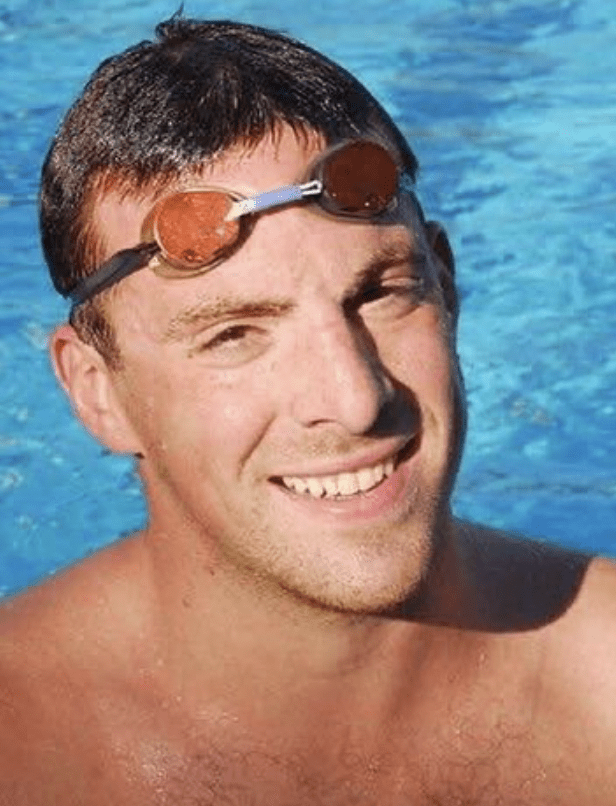
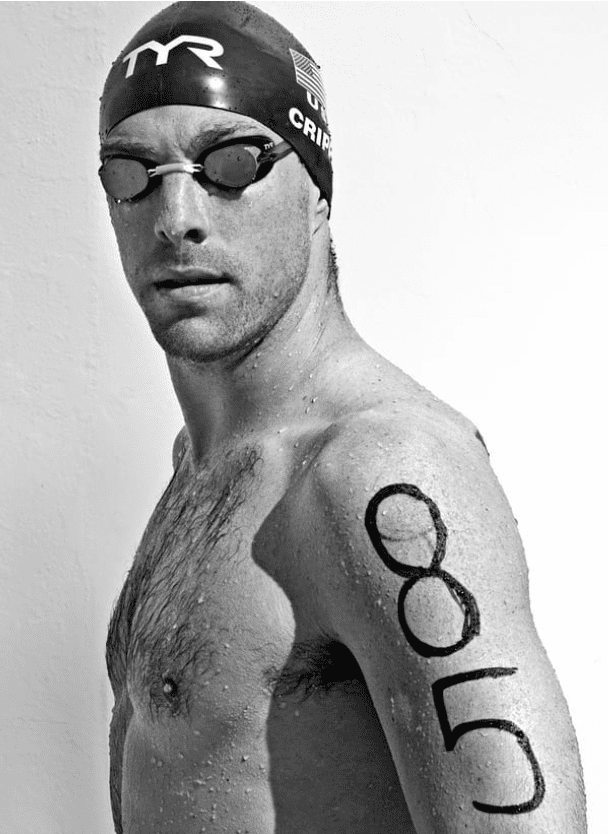
Prior to the untimely death of International Marathon Swimming Hall of Fame Honor Swimmer Fran Crippen (USA, MSF bio here, Foundation here) at a FINA 10km Marathon Swimming World Cup race in the United Arab Emirates in October 2010, there was very little public attention and knowledge about the dangers of hyperthermia.
Most of the attention and knowledge in the open water swimming community was focused on hypothermia.
So while hypothermia is a state of experiencing abnormally low body temperatures due to prolonged exposure to cold water and conditions, especially when combined with chilly winds and fatigue, hyperthermia is the exact opposite. That is, hyperthermia is a state of experiencing abnormally high body temperatures that result from warm water, warm temperatures, bright skies with intense solar radiation and/or humidity.
Several degrees of severity exist in both hypothermia and hyperthermia that can, sadly in the case of Crippen, end in death.
“Prior to Fran’s death in 2010, there were several dozens of other deaths in the open water among swimmers and triathletes,” recalled Steven Munatones. “I had been documenting these deaths for a while since I felt the safely standards needed to improve – as Fran and I had discussed a few times before his passing. The triathlon community recognized this problem with hyperthermia well before the open water swimming community did, even though I brought it to the attention of [FINA Executive Director] Cornel Marculescu a year earlier than Fran’s death.
With Fran no longer with us, there was a renewed global introspection of open water swimming safety standards. FINA, to its credit, subsequently implemented a variety of new safety measures, including setting a maximum water temperature of 31°C (87.8°F).
But then came the 2011 FINA World Aquatics Championships in Shanghai, when I believe the air and water temperature hovered right around 31°C at the start and definitely rose above 31°C as the sun came up during the 25 km championship race. So many of the world’s best and most experienced marathon swimmers aborted the swim – see results below. I also had to dive in the water and rescue Antje Mahn, a German swimmer, at the request of her coach. I bought her to shore where she was immediately taken to a local hospital – where other swimmers were being treated. The conditions – so soon after Fran died – were so bad that the two reigning world 25 km champions Linsy Heister (Netherlands, MSF bio here) and Thomas Lurz (Germany, MSF bio here) did not even start the race* because of the extraordinarily high water temperatures and extreme conditions.”
Dial forward from 2011 to 2026 and the sport of open water swimming continues to evolve for the better.
World Aquatics seeks cutting-edge research to enhance athlete safety in open water swimming competitions
World Aquatics acknowledges that there is a need for updated research on the topic of water temperatures.
On its website [see here], World Aquatics reported that its maximum water temperature limit remains 31.0°C. Its current standard was established following research conducted by the University of Otago in 2013 under the leadership of Dr. David Gerrard on behalf of World Aquatics, World Triathlon, and the International Olympic Committee. During this testing, the researchers tested swimmers who swam for 20, 60, and 120 minutes at water temperatures ranging from 20°C to 32°C under outdoor-relevant ambient conditions.
Request for Proposal for Safe Maximum Water Temperature Limits
World Aquatics launched a comprehensive Request for Proposal to commission new research on Safe Maximum Water Temperature Limits for Open Water Swimming Competitions. This initiative represents a proactive approach to athlete safety, noting that thermal stress in aquatic sports requires a specialized understanding, distinct from land-based endurance activities.
The project aims to address several critical questions, including:
- How do water temperature, ambient conditions, and humidity collectively affect athlete safety and performance?
- Which physiological and demographic factors shape thermal tolerance in competitors?
- What evidence-based recommendations will support improved competition guidelines?
For more information, visit https://www.worldaquatics.com/about/tenders.
Perspectives
“I greatly appreciate this initiative as new research is absolutely needed. Water temperatures and air temperatures are slowly, but gradually, increasing around the world,” comments Munatones. “The marathon running community is rightly concerned about this trend – and so should the open water swimming community. This is especially true because swimmers – unlike runners – often wear tight compression wear (tech suits) that are all black during their races. These tech suits not only serve to make swimmers more buoyant in the water, but they also attract so much solar radiation, especially on bright, sunny summer days. These all-black tight tech suits cover the swimmer’s body from their shoulders to their ankles; their bodies are encased in heat-generating attire, causing their internal body temperatures to rise as they are gradually getting dehydrated in a competitive swimming environment.
If there is an unintended recipe for hyperthermia, I cannot think of any better conditions than this – especially since the swimmers also wear rubber swim caps.”
In summary, it is excellent that World Aquatics wants sports scientists to not only consider high water temperatures in their research project, but also to incorporate testing of challenging ambient conditions (including solar radiation and humidity), the use of all-black compression tech suits and swim caps during an intense 2-hour competition, and potential pre-race acclimatization training (to heat, humidity, and sunny conditions).
But it will also be critical to take these research findings and standardize safety measures, especially the more often open water competitions are held in warm water and warm weather conditions.
2011 FINA World Championships 25 km Race – Men’s Results
- Petar Stoychev, Bulgaria 5:10:39.8
- Vladimir Dyatchin, Russia 5:11:15.6
- Csaba Gercsák, Hungary 5:11:18.1
- Francisco Jose Hervas Jodar, Spain 5:11:20.4
- Trent Grimsey, Australia 5:11:28.2
- Allan do Carmo, Brazil 5:11:32.2
- Vasily Boykov, Russia 5:11:36.3
- Joanes Hedel, France 5:13:03.1
- Yuri Kudinov, Kazakhstan 5:13:08.6
- Libor Smolka, Czech Republic 5:13:20.1
- Bertrand Venturi, France 5:13:26.9
- Erwin Maldonado, Venezuela 5:14:03.5
- Guillermo Bertola, Argentina 5:14:29.9
- Simon Tobin, Canada 5:19:43.1
- Xavier Desharnais, Canada 5:20:44.2
- Samuel de Bona, Brazil 5:27:38.1
- Han Lidu, China 5:32:02.1
- Gabriel Villagoiz, Argentina 5:37:25.9
- Weng Jingwei, China 5:47:16.0
- DNF Josip Soldo, Croatia
- DNF Valerio Cleri, Italy
- DNF Rok Kerin, Slovenia
- DNF Tomislav Soldo, Croatia
- DNF Rostislav Vítek, Czech Republic
- DNF Gergely Kutasi, Hungary
- DNF Angel Moreira, Venezuela
- DNF Codie Grimsey, Australia
- DNF Edoardo Stochino, Italy
- DNF Benjamin Konschak, Germany
- DNS Tom Vangeneugden, Belgium
- DNS Islam Mohsen, Egypt
- DNS Alex Meyer, USA
- DNS Brian Ryckeman, Belgium
- DNS Mazen Mohamed Aziz, Egypt
- DNS Thomas Lurz, Germany
2011 FINA World Championships 25 km Race – Women’s Results
- Ana Marcela Cunha, Brazil 5:29:22.9
- Angela Maurer, Germany 5:29:25.0
- Alice Franco, Italy 5:29:30.8
- Olga Beresnyeva, Ukraine 5:29:35.6
- Martina Grimaldi, Italy 5:29:36.2
- Anna Uvarova, Russia 5:29:38.9
- Celia Barrot, France 5:29:40.8
- Margarita Dominguez Cabezas, Spain 5:29:42.0
- Silvie Rybarova, Czech Republic 5:29:51.3
- Cecilia Biagioli, Argentina 5:29:58.7
- Maria Bulakhova, Russia 5:34:21.2
- Karla Šitić, Croatia 5:37:49.8
- Esther Nunez Morera, Spain 5:38:09.6
- ash Harrison, Australia 5:53:35.4
- Cao Shiyue, China 5:54:21.9
- Sun Minjie, China 5:55:16.3
- Nika Kozamernik, Slovenia 6:00:43.8
- DNF Jana Pechanová, Czech Republic
- DNF Zaira Edith Cardenas Hernandez, Mexico
- DNF Antje Mahn, Germany
- DNF Claire Thompson, USA
- DNS Linsy Heister, Netherlands
- DNS Haley Anderson, USA
© 2026 Daily News of Open Water Swimming
“to educate, enthuse, and entertain all those who venture beyond the shoreline“
World Open Water Swimming Federation, a human-powered project
New Open Water Swimming Educational and Motivational Course – register here