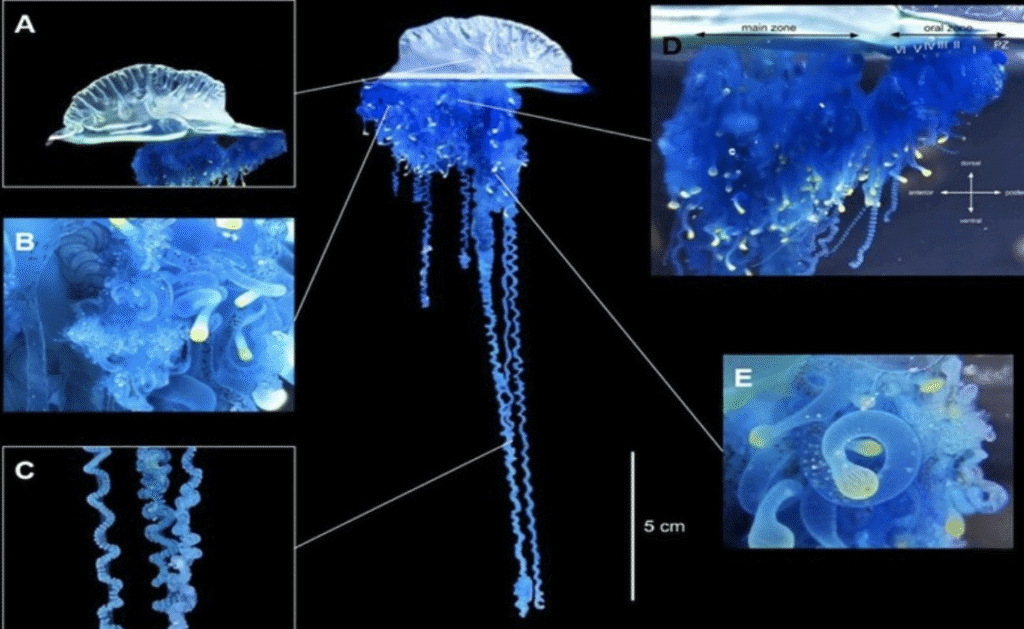
Photo courtesy of ITmedia NEWS.
For those who are planning ocean swims in northern Japan next year and beyond (in Tsugaru Channel and Sado Channel), this is definitely news that you do not want to hear.
A new species of poisonous jellyfish, Mikazuki no Eboshi – related to the Portuguese man o war – was discovered in Sendai Bay by Tohoku University scientists, probably moving northwards due to ocean temperature changes.
The Portuguese man of war is lives, floats, and stings (painfully) throughout tropical and temperate waters around the world. Its stings are not as terrible as those of the box jellyfish, but they are extremely painful nevertheless. Adam Walker felt the painful stings of man o war towards the end of his 16 hour 2 minute Molokai Channel crossing in Hawaii in 2012.

In Japan, another kind of Portuguese man o war species is well-known and typically found ranging from Okinawa in Japan’s far south region to Sagami Bay near Tokyo. But, to date, no jellyfish of this type has been seen in Japan’s northern regions – that includes the Tsugaru and Sado Channels.
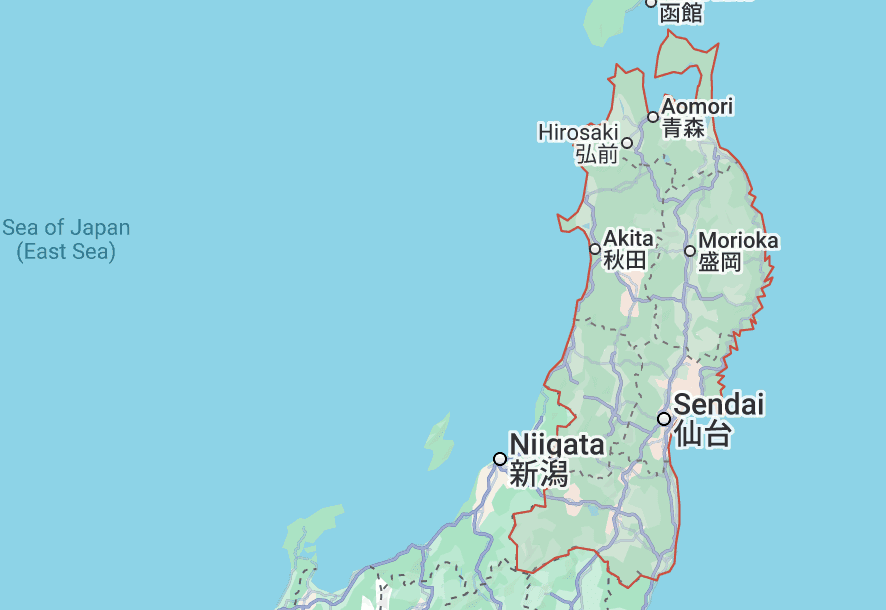
A research team from Tohoku University found that the Kuroshio Current (begins off the east coast of Taiwan and flows northeastward past Japan) has been experiencing abnormally high sea surface temperatures and may have carried the new species to Japan’s northern regions.
The researchers found that the Kuroshio Current has moved in the northward direction by approximately 100 km in recent years, and that the sea surface temperature in northern Japan has risen by 2 to 4°C over a 2-year span.
Since ocean temperatures are expected to keep on rising, this movement of a Portuguese man o war towards northern Japan is most definitely not good news for channel swimmers.
© 2025 Daily News of Open Water Swimming
“to educate, enthuse, and entertain all those who venture beyond the shoreline“
World Open Water Swimming Federation, a human-powered project.
if stung get a hot shower as soon as you possibly can