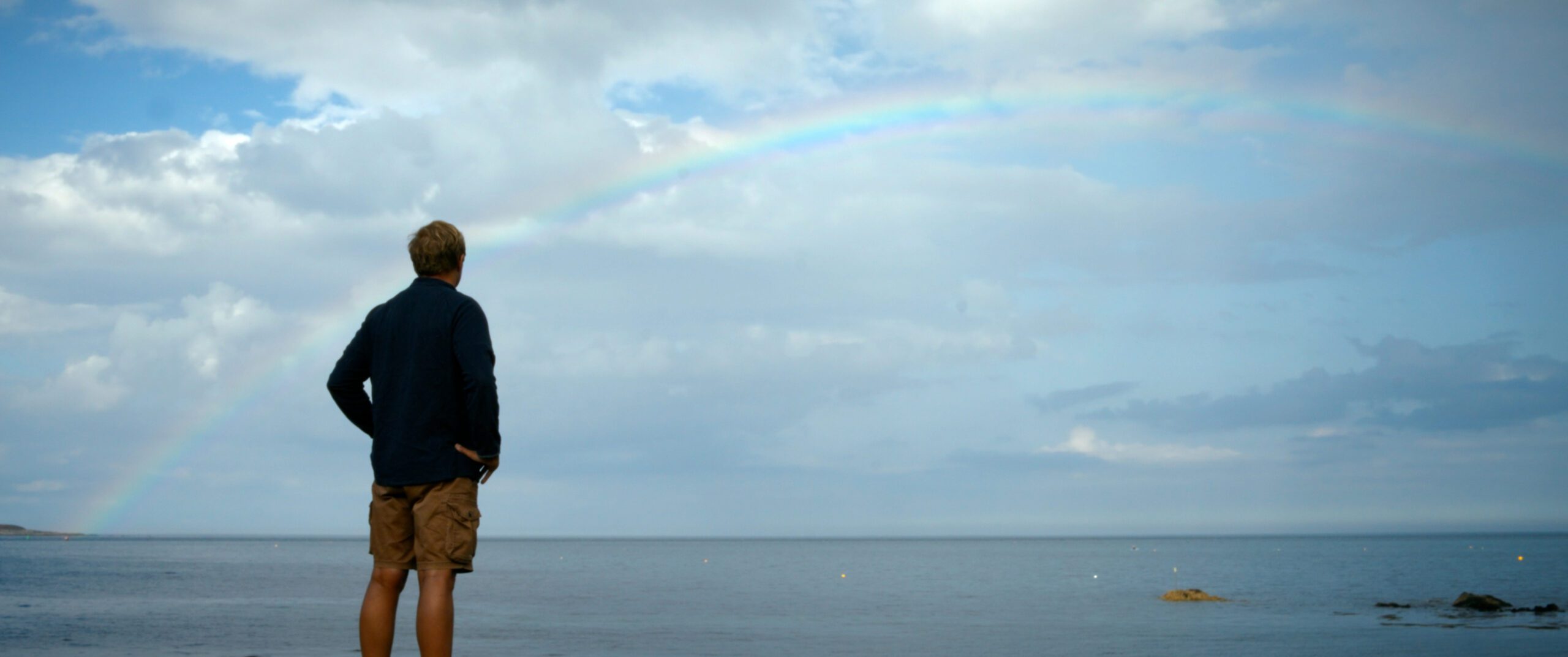
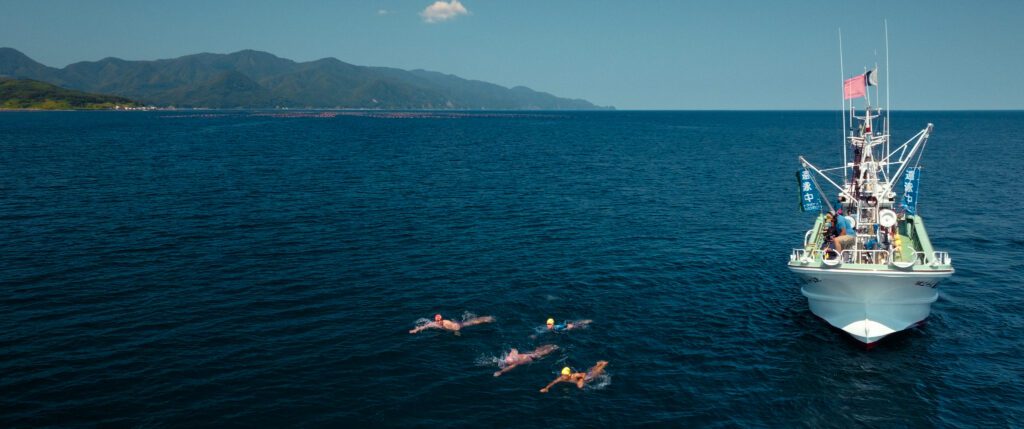
It was a long time coming – over 10 years – but Mark Sowerby (52, Australia, MSF bio here) finally achieved the Oceans Seven with unique crossing of the Tsugaru Channel between Honshu and Hokkaido in northern Japan in July 2024.
He not only endured a rapid change in water temperature – from 22°C to 14°C – but also a complete shift in the water flow due to an earthquake. Sowerby literally swam through an underwater tsunami that no one saw coming.
There were two unique happenings during Sowerby’s 10 hour 6 minute crossing that Captain Kawayama, coach Tim Denyer (@redtopperformance), and support crew could not explain. They simply chalked it up to the unique topography, general geomorphology of the area, and the natural phenomenon of the Tsugaru Current.
A 90° Course Shift
Mid-channel at a depth of 200 meters around 4 hours after his start in Aomori Prefecture on Honshu, Sowerby took an inexplicable sharp turn towards the east (see below). There was no conscious effort to make a dramatic – or even modest – change in his swimming orientation or direction. Neither Captain Kawayama nor Coach Denyer specifically remembered making a sudden shift that was identified by his GPS coordinates. Then without another conscious effort, he returned to his intended course and carried on to Hokkaido, his ultimate goal.

A Massive Water Temperature Shift
Approximately two hours from his finish, about 8 hours into his swim, Sowerby suddenly stopped because he felt a dramatic drop in the water temperature. The water temperature within a 100-meter area at a depth of between 50-70 meters decreased from 20°C to 14.5°C. The tough Aussie was hardened, but the water temperature shift was a kick to the gut and made him focus.
Sowerby did not specifically see anything particular during either the course shift or the temperature shift. “As far as the sunlight reached the depths, I could see deep below in the clear waters of Tsugaru,” he recalls.
What occurred?

An Earthquake Hit Northern Japan
A magnitude 2.5 earthquake hit the Sea of Japan at 8:14 am – which was 4 hours 8 minutes after Sowerby started on the Kodomari Cape.
The earthquake had a very shallow depth of 7.2 km and was not felt on dryland in the area. Its earthquake epicenter was 40.633°N / 139.12°E while Sowerby was approximately at 41.1243°N / 140.2479°E or about 513 km to the east.
Tsunamis can move at great speeds and have tremendous energy, but its speed depends on the depth of the water it is traveling through (see here). In deeper water, the water moves faster. At a depth of 200 meters, the speed of a tsunami is 159 kph. The ocean at the epicenter was greater than 200 meters, but where Sowerby was swimming, the depth was 200 meters.
It was assumed that the displacement of the water at the epicenter could have impacted the surface waters across the Tsugaru Channel and direction and speed of the Tsugaru Current four hours after the earthquake hit.
It is also reasonable to assume that the displacement of the water could have impacted the water temperatures at a later time as the cold water from below gradually mixed with warmer water at the surface – resulting in a 6.5°C temperature drop.


Conjecture
Sowerby’s crossing started with very light winds and unexpectedly warm (22°C) water temperatures at the start in Kodomari on Aomori Prefecture.
Could the magnitude 2.5 earthquake impact the flow of water – that always flows in the eastward direction across the Tsugaru Channel – and the surface water temperatures? Quite possibly.
But his agony ultimately turned into a successful crossing and the triumphant completion of the Oceans Seven.
Don’t Be Prey
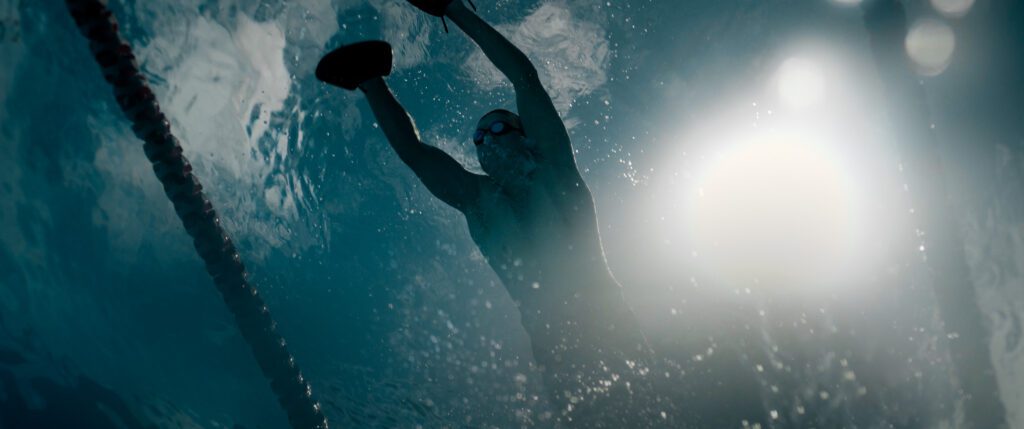
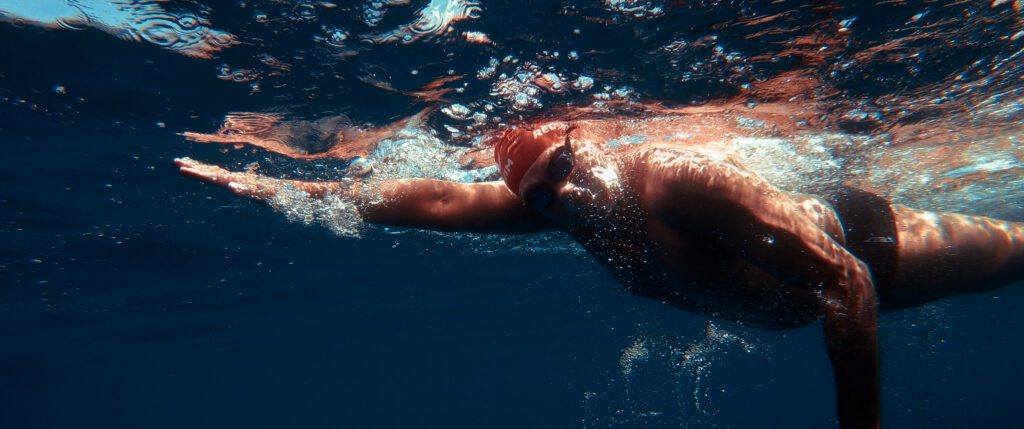
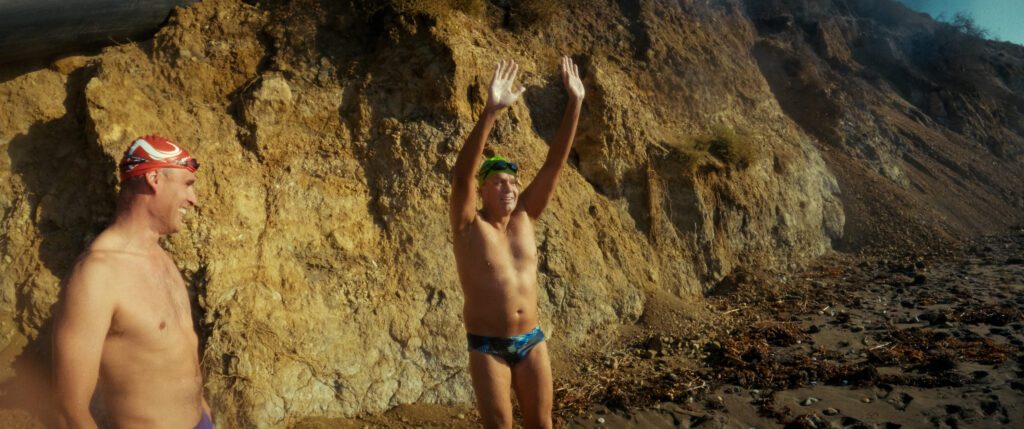
Sowerby’s decade-long Oceans Seven journey is told in a 1 hour 31 minute biopic titled Don’t Be Prey (@dontbeprey.film, IMDb here).
The official opening weekend in the UK is March 20th.
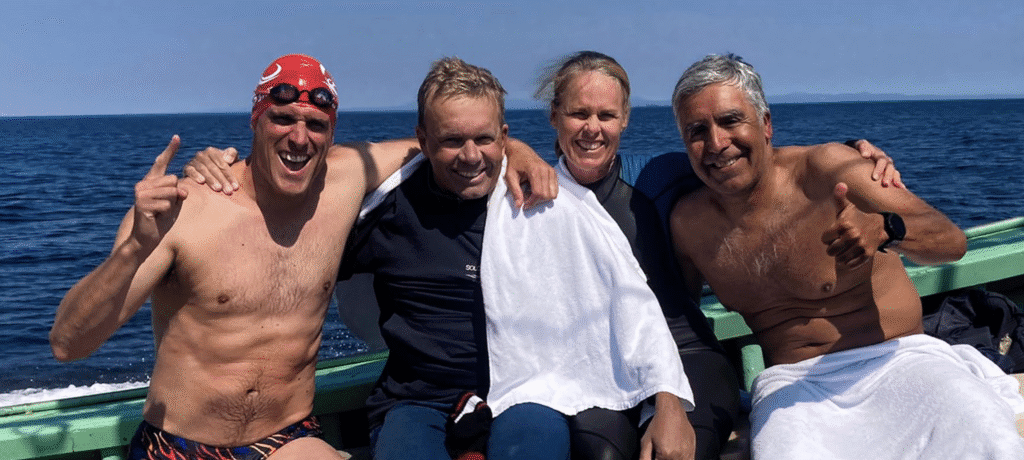
Tseng says, “We’re running a national tour across the UK and Ireland from March 4th – 19th with Q&A sessions featuring Mark, Tim, and local swimmers.”
Director Jeff Tseng explains, “Don’t Be Prey is not concerned with the outcome of success, but with how a person learns to live with themselves amid prolonged uncertainty.
Throughout the filming process, I continually reminded myself not to turn the protagonist into a hero. While the ocean pushes the body to its physical limits, the real struggle never takes place in the water; it unfolds internally. Mark is not a conventional heroic figure. His strength does not come from talent, but from his ability to remain present with pain rather than escape it. I did not shy away from his flaws: his need for control, emotional distance, and near-obsessive determination are integral to the narrative because they form the internal barriers he must confront. His transformation is not about becoming stronger, but about shifting from control to trust — trust in the process, trust in others, and trust in uncertainty itself.
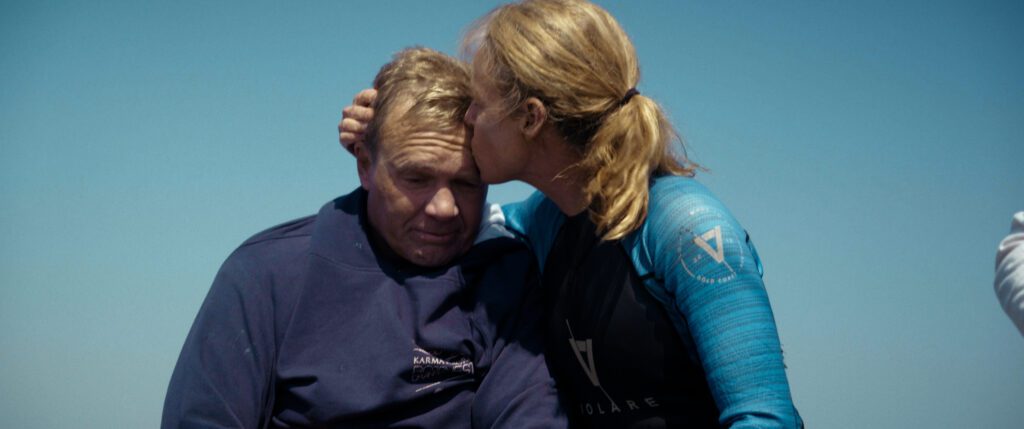
The people around him carry equal emotional weight. His coach – Tim – transforms the deepest wounds of his own life into a source of strength, choosing to heal himself by helping others. His wife – Heidi – chooses presence at her husband’s lowest point. Through these intertwined relationships, I wanted to express a different understanding of courage in the face of adversity: not the courage to conquer, but the courage to stay; not the absence of fear, but the refusal to let fear make one’s decisions.“
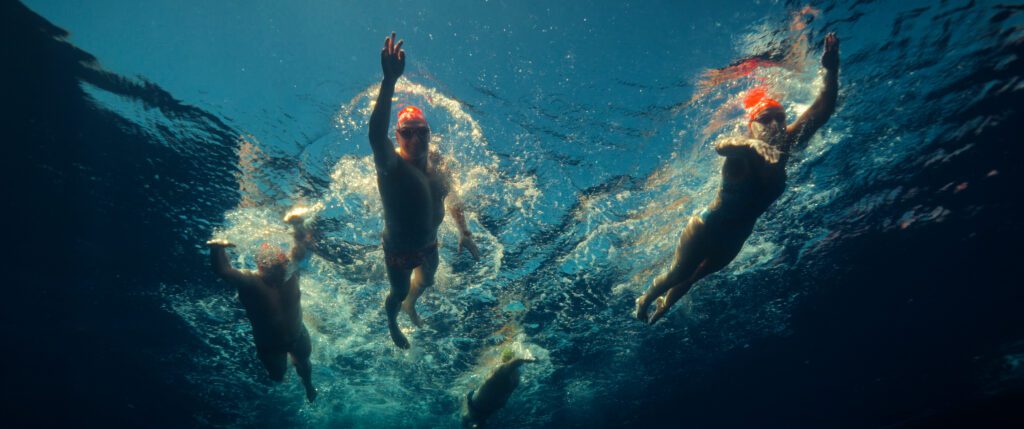
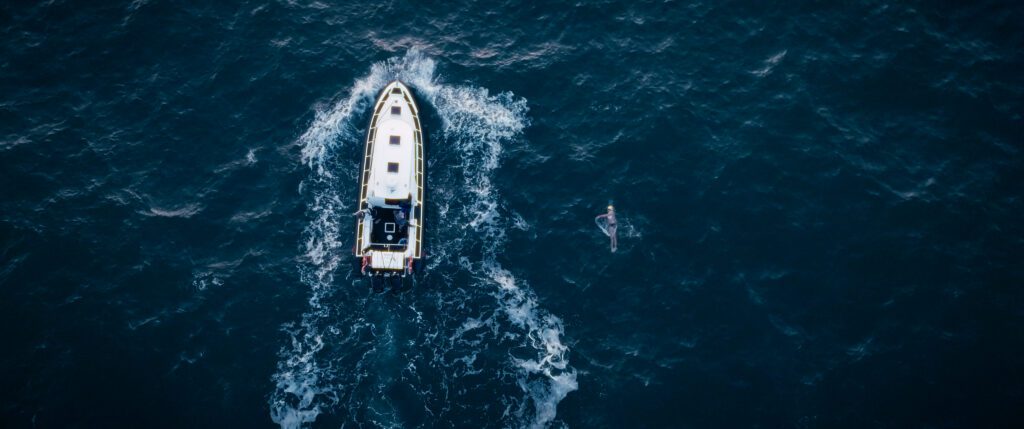
Don’t Be Prey on IMDB is here.
Don’t Be Prey on Letterboxd is here.
Main Characters
Mark Sowerby’s life was upended in 2018 when a highly publicised short-selling attack on Blue Sky dismantled his reputation, identity, and self-belief. Turning to the ocean not for glory but for survival. Mark utilises marathon swimming as a mechanism to master fear and navigate the paralysis of prolonged uncertainty. Over the course of a decade, he attempts the Oceans Seven—a grueling odyssey through cold, darkness, and apex predators. By his final crossing, Mark’s journey transcends mere physical endurance, evolving into a profound reclamation of self, achieved only by surrendering control to a team he learns to trust implicitly.
Tim Denyer is an elite tactician whose uncompromising standards are inextricably linked to personal tragedy. A former channel swimmer, Tim bears the silent weight of having witnessed his own mentor perish in his arms during a crossing – a trauma that cemented his rigid, safety-first methodology. He offers empathy but withholds sympathy, operating within a binary philosophy where unchecked emotion is a precursor to fatal error. Viewing his own redemption through the lens of Mark’s survival, Tim pushes his athlete to the physiological brink, possessing the visceral knowledge of exactly what is required when the ocean turns unforgiving.
Heidi Sowerby embodies the emotional gravity of the film, carrying the weight of her family while her husband confronts his existential demons at sea. Initially paralysed by the mortal risks inherent in Mark’s pursuit, she evolves from an anxious observer into an indispensable strategist, becoming the only voice capable of reaching him when he descends into a psychological void of suffering. Her arc mirrors Mark’s own transformation; moving from fear to agency, she eventually plunges into the freezing waters herself to guide him home.
As the creator of the Oceans Seven, Steven Munatones serves as the film’s philosophical conscience. A legendary figure in the sport, he contextualises Mark’s endeavour not merely as an athletic feat, but as a primal dialogue between “human power and Mother Nature”. Steven lives by the ethos of the encyclopedia-bound explorers he idolised as a child, maintaining that comfort is the antithesis of a life well-lived. Having survived a catastrophic heart attack, he brings a poignant awareness of mortality to the narrative, reminding both the audience and Mark that the ultimate victory lies in refusing to become “prey” to life’s unpredictability.
Filmmakers
Jeff W. Tseng, Writer/Director/Producer, is the co-founder of PixelFrame, a production company based in Australia. The company’s scope of work includes film production, documentaries, web series, commercials, animation and international production facilitation services. In 2011, he was appointed to the board of the Queensland School of Film and Television and currently serves as the Director of Curriculum at the institute. Several of the projects he has produced have been recognized at international film festivals, including Slamdance, the Vancouver International Film Festival, Sydney Flickerfest,, Taiwan Golden Horse Film Festival, SSFF & ASIA Short Film Festival in Japan, the Bucheon International Fantastic Film Festival in South Korea, Hollywood Screamfest, and the Brisbane International Film Festival.
Steven Sander, Writer/Editor, is an Emmy award-winning feature drama and documentary editor. In 2023, he received the Australian Screen Editors award for Best Editing of a Documentary Feature and, in 2024, the Australian Writers’ Guild award for Best Writing of a Documentary, both for Volcano Man. Steven recently cut The Thinking Game, which had its world premiere at the 2024 Tribeca Festival. Previously Steven won an Emmy for the US feature documentary Of Miracles And Men, part of ESPN’s acclaimed 30 for 30 TV series. His debut feature, New Town Killers, received three BAFTA Scotland Nominations (Best Film, Best Director, Best Actor). Steven also writes and directs and currently combines his work as a feature film editor with commercials and documentary directing.
Caitlin Johnston, Producer, is a creative producer, whose enthusiasm and desire to completely immerse in the world of filmmaking has given her broad experience across many platforms and productions. Over ten years in the business, she’s coordinated entire departments in blockbuster international productions, co-produced her own low-budget feature film ‘Eight’ (streaming on Amazon Prime – humble brag), produced and directed multiformat promotional campaigns for a wide range of clients … and everything in between. As one of the lead creative producers at PixelFrame, her primary focus is on human-interest factual and documentary content. She’s had the incredible privilege of sharing stories with heart and vulnerability, from people from all walks of life. Her most recent achievement includes producing and directing the 12-part webs series ‘She Made It’, which is fresh on the festival circuit and has already collected numerous accolades.
Lucas Thyer, Executive Producer, is an acclaimed filmmaker and creative producer with a career spanning more than twenty years. As the co-founder of the Australian production company PixelFrame, he brings a deep passion for storytelling and a commitment to excellence to every narrative he crafts. His distinctive visual style and extensive technical expertise make him a leader in his field. His body of work spans a wide range of formats and genres, with a strong focus on documentary, online content campaigns, and the arts and live performance. Lucas is known for his proactive and grounded approach, infusing each project with his unique creativity, infectious enthusiasm, and energy. His dedication to high-quality storytelling has earned his work recognition and awards at prestigious festivals worldwide, including the Brisbane International Film Festival, Tropfest, the St Kilda Film Festival, and Flickerfest.
Don’t Be Prey on IMDB is here. Don’t Be Prey on Letterboxd is here.
© 2026 Daily News of Open Water Swimming
“to educate, enthuse, and entertain all those who venture beyond the shoreline“
World Open Water Swimming Federation, a human-powered project
New Open Water Swimming Educational and Motivational Course – register here