

Dina Levačić (30, Croatia, MSF bio here, @dinalevacic_swim) is an Honor Swimmer in the International Marathon Swimming Hall of Fame in its Class of 2025 – and en route to earning her PhD.
Levačić has been a racer, a record holder, a public speaker, a cover girl [see below*], and a solo swimmer who has achieved both the Triple Crown of Open Water Swimming in 84 days in 2017 and the Oceans Seven.
But she added one more role to her expansive resume: that of a researcher. She recently published a paper titled, “Health, Risk and Adaptation in Extreme Open Water Swimming: A Qualitative Study of Channel Swimmers” [see here].
For the study, she interviewed 10 female and 20 male marathon swimmers who ranged in age between 30-70 with an average age of 49. Eleven of the swimmer have completed the Oceans Seven while 4 swimmers have completed six of seven channels and the remainder have completed at least two of the seven channels. The swimmers came from Australia (4), Germany (1), Hungary (1), India (1), Ireland (3), Mexico (1), Netherlands (1), New Zealand (1), Russia (1), South Africa (1), Sweden (1), Turkey (1),UK (2), and the USA (11). So it was an experienced group of subjects who Levačić studied.
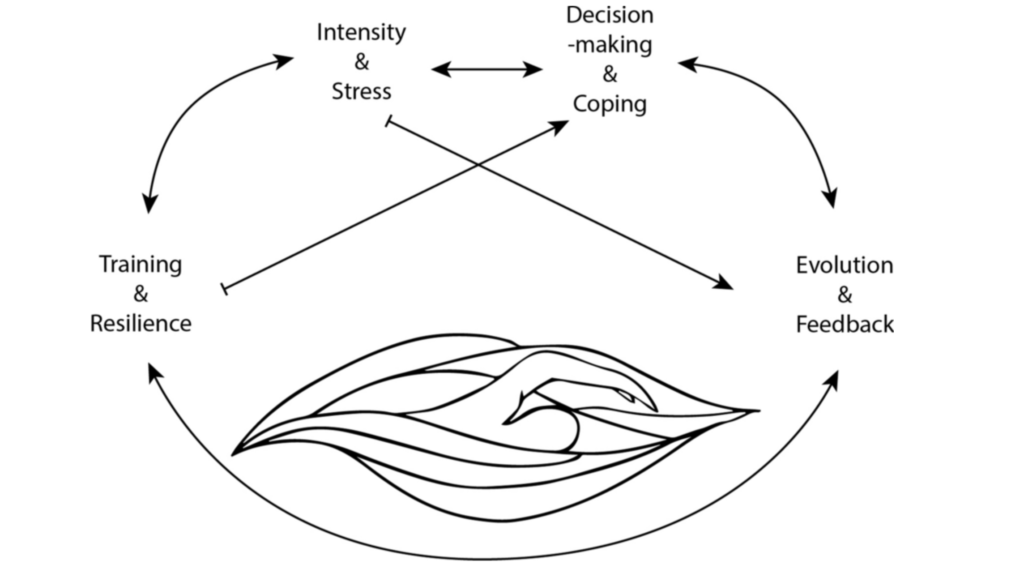
It was a comprehensive paper that resulted in TIDE, a nonlinear framework that captures the dynamic, adaptive nature of marathon swimming. Levačić found that the swimmers experience a continuous feedback loop where preparation, challenge, coping, and recovery interact to shape their performance and continuous learning.
Levačić writes, “The most notable finding was how swimmers perceive injury and physical discomfort, especially shoulder injuries, not as medical emergencies but as normal and sometimes expected in channel swimming. Pain was often described as unavoidable, reflecting a shared view within channel swimmers’ culture that enduring pain is an essential part of channel swimming. This normalization aligns with previous findings on overuse injuries and further provides insight into how community narratives shape athletes’ interpretations and responses to pain. For many, pain became a badge of honour rather than a warning sign. This perception can affect long-term health, particularly among less experienced swimmers, who may accept these attitudes without the same depth of lived experience and knowledge.”
Read the entire paper here.
Levačić appeared on the cover of @ellecroatia:


© 2026 Daily News of Open Water Swimming
“to educate, enthuse, and entertain all those who venture beyond the shoreline“
World Open Water Swimming Federation, an exclusively human-powered project