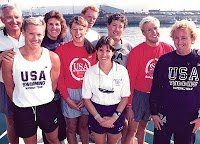
 36 years ago, the American team of Chad Hundeby, Martha Jahn, Karen Burton, Jay Wilkerson, Dirk Bouma, and Sid Cassidy [photo shown on right] set a England-to-France relay record in 6 hours 52 minutes and carried on to also set the France-to-England relay record with a second leg in 7 hours 26 minutes.
That incredible two-way record of 14 hours 18 minutes has stood the test of time, despite modern-day advantages in swimwear, overall cumulative knowledge, and the use of GPS.
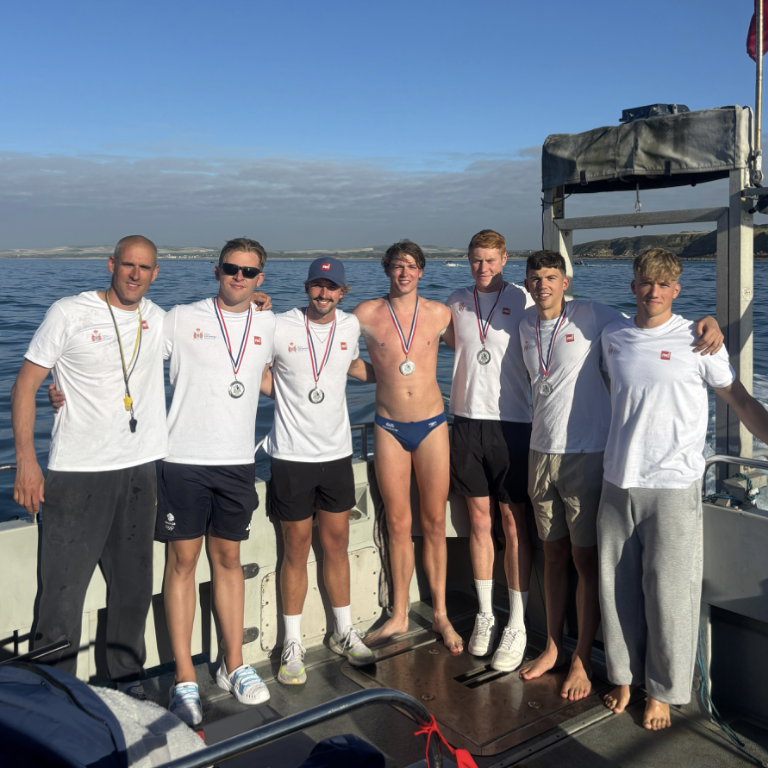
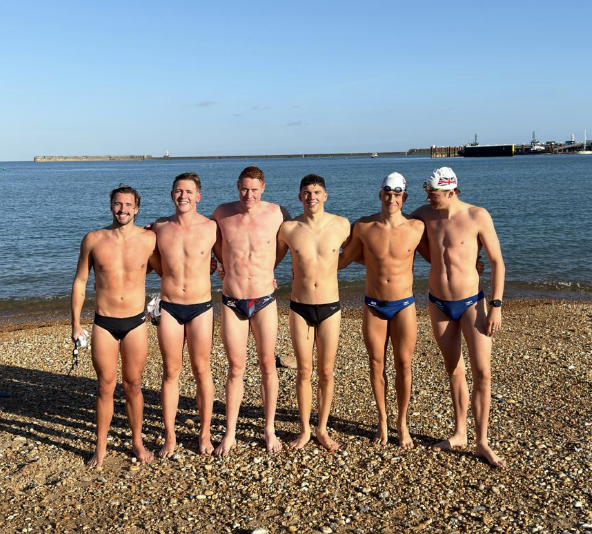
The Spirit of Great Britain gave it their best shot today. The team consisting of 3-time Olympic gold medalist Tom Dean, MBE (26, Great Britain, World Aquatics bio here, @tomdean00), British national champion and 2024 World Aquatics Swimming Championships competitor Joshua Gammon (23, Great Britain, World Aquatics bio here, @josh.gammon), Lake Windermere course record holder George Taplin (28, Great Britain, @georgetaplin), 2020 Tokyo Olympic finalist and 2024 Paris Olympics distance freestyler Daniel Jervis (30, Great Britain, World Aquatics bio here, @danieljervis1), and 2024 Paris Olympics marathon swimmer Toby Robinson (30, Great Britain, World Aquatics bio here, @tobiasrobinson), and 2-time Olympic marathon swimmer Hector Pardoe (25, Great Britain, World Aquatics bio here, @hectorpardoe) was supported by Red Top Performance coach Tim Denyer (47, Great Britain, @redtopperformance) and escorted by two International Marathon Swimming Hall of Fame pilots Reg Brickell and Ray Brickell.
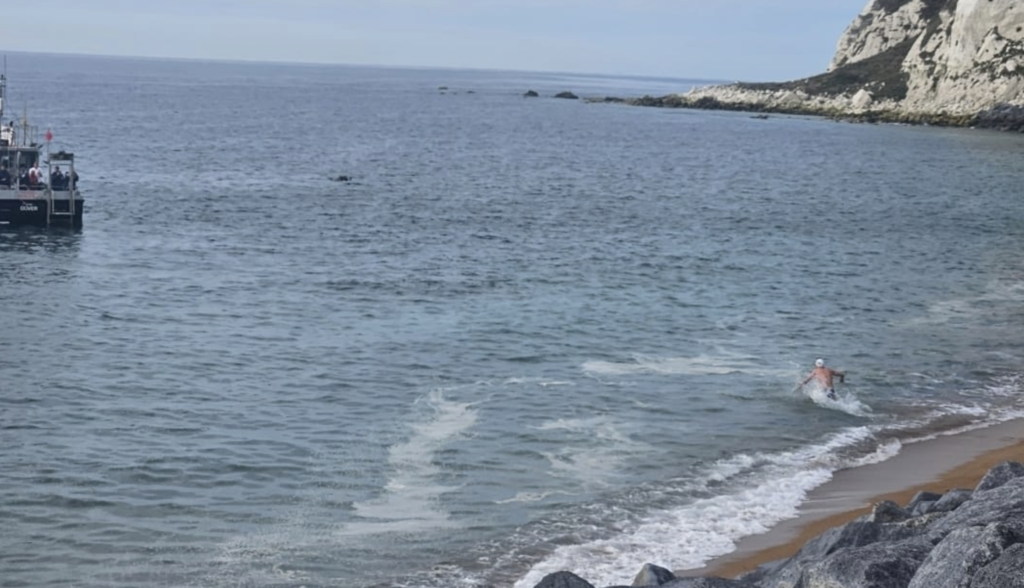
Pardoe kicked off the team’s effort in 18°C water as he ran off Shakespeare Beach in a sprint of 60 minutes [see photo above].
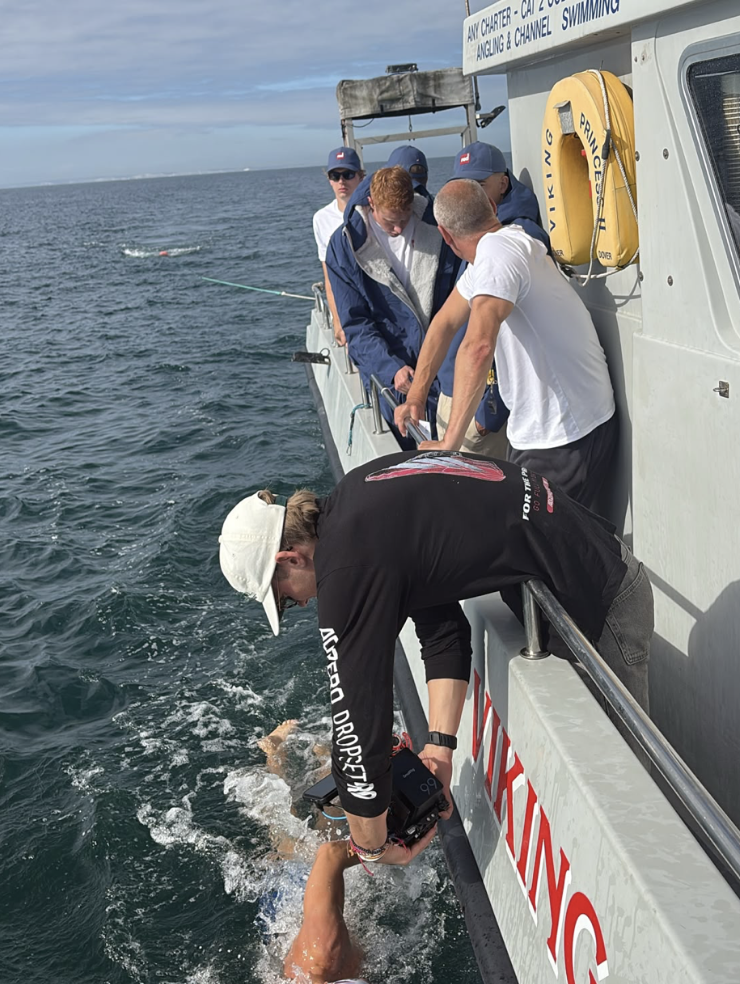
Pardoe was followed, in order, by Taplin, Robinson, Jervis, Dean, and Gammon.
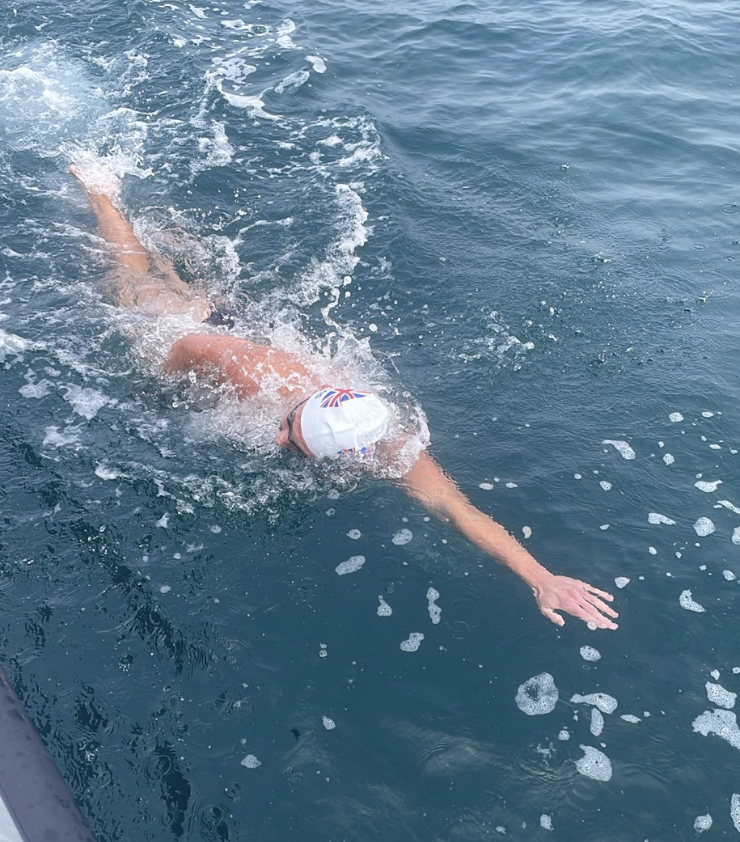
Each man swam the regulation 60-minute legs.
As The Spirit of Great Britain approached the French shore, Pardon jumped in as the team’s anchor leg. It was going down to the finish as Pardon – who finished sixth in the 2024 Paris Olympics marathon swim – gave it his all.
But as the waters swirling around Cap Gris-Nez, it was not to be.
The Spirit of Great Britain finished in 6 hours 55 minutes, swimming under the auspices of the Channel Swimming Association. They did break the previous British record held by the Dover Life Guard Club of 7 hours 17 minutes, set in 1981.
Today’s live tracker of the English Channel is posted here.
The Americans retained their record, but The Spirit of Great Britain generated significant interest in Channel swimming and and awareness in the Royal Life Saving Society UK programs.
Royal Life Saving Society UK
The Spirit of Great Britain attempted to break the course record as a charity event for the Royal Life Saving Society UK in a campaign called Back the Swim. Break the Record. Save Lives.
See here to support their fundraising efforts.
For additional information, visit previous articles here and here.
When I think about how the Americans of yesterday swam faster, there is one good point that was raised by Sid Cassidy, “Maybe the psychological aspect had a little to do with [how well we swam]. Remember, all of our swimmers were marathon swimmers [in an era where marathon races were a minimum of 25 km]. We were coming down [from 25 km – 40 km distances] to swim one-hour legs [of about 5 km]. So in our minds, it was a real sprint instead of a 5 or 6 or 7 hour race. For us it was a short leg of longer marathon swims.
I am certain the British swimmers were putting a lot more pressure on themselves than we had in our day. In contrast, it was just a joy and a fun swim for us – more than anything we were doing at that time. The real pressure came the next week in Lake Windermere when they all had to swim 25 km international championships.“
It sure would be very interesting to compare the logs from the two crossings if they are available.
© 2026 Daily News of Open Water Swimming
“to educate, enthuse, and entertain all those who venture beyond the shoreline“
World Open Water Swimming Federation, an exclusively human-powered project.