
There are currently a growing plethora of books on competitive swimming and open water swimming. We are in, without a doubt, the golden age of swimming books.
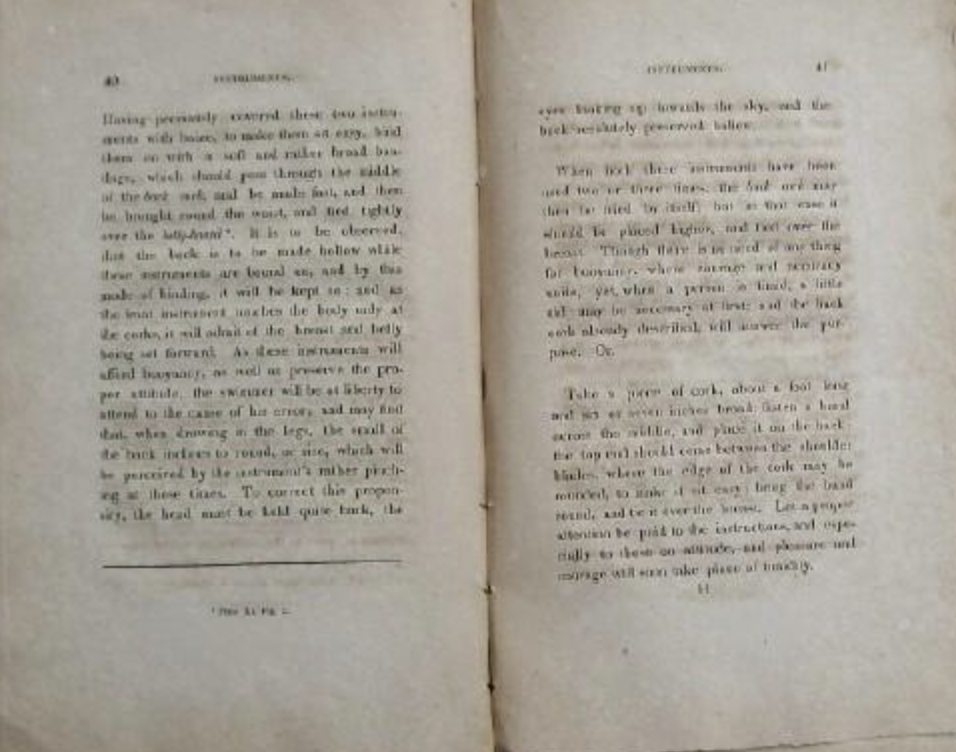
J. Frost was a British swimming instructor from Nottingham, England. He wrote the first American edition of The Art of Swimming. A Series of Practical Instructions on an Original and Progressive Plan that was published in 1818 by P.W. Gallaudet. Frost wrote original ideas on swimming including the importance of floating, of learning strokes on land, the wearing of a thin calico bathing suit, and the use of a thin board with cork to float.
In his 72-page book with 12 engraved illustrations, his book also included the text of a 1760 letter from Benjamin Franklin to Oliver Neale with swimming instructions [reprinted below] which was influential in subsequent instructional works on swimming and was called Dr. Franklin’s Treatise.
The book is described as “a series of practical instructions on an original and progressive plan, by which the art of swimming may be readily attained, with every advantage of power in the water: accompanied with 12 copper-plate engravings, comprising 26 appropriate figures, correctly exhibiting and elucidating the action and attitude, in every branch of that invaluable art.”
Front wrote an earlier edition that was initially published in London in 1816 and was titled Scientific Swimming. A Series of Practical Illustrations on an Original and Progressive Plan.
Frost’s work is referred to as the second original English treatise on swimming. Everard Digby was the first with his De Arte Natandi Libri Duo, produced in 1589 and translated in 1595.
Dr. Franklin’s Treatise
Benjamin Franklin wrote a passage in Frost’s The Art of Swimming book, “I cannot be of opinion with you that it is too late in life for you to learn to swim. The river near the bottom of your garden affords a most convenient place for the purpose. And as your new employment requires your being often on the water, of which you have such a dread, I think you would do well to make the trial; nothing being so likely to remove those apprehensions, as the consciousness of an ability to swim to the shore, in case of an accident, or of supporting yourself in the water till a boat could come to take you up.
I do not know how far corks or bladders may be useful in learning to swim, having never seen much trial of them. Possibly they may be of service in supporting the body while you are learning what is called the stroke, or that manner of drawing in and striking out the hands and feet, that is necessary to produce progressive motion. But you will be no swimmer, till you can place some confidence in the power of the water to support you: I would therefore advise the acquiring that confidence in the first place; especially, as I have know several, who, by a little of the practice necessary for that purpose, have insensibly acquired the stroke, taught as it were by nature.
The practice I mean is this. Choosing a place where the water deepens gradually, walk coolly into it till it is up to your breast, then turn round, your face to the shore, and throw an egg into the water, between you and the shore. It will sink to the bottom and be easily seen there, as your water is clear. It must lie in water so deep as that you cannot reach it to take it up but by diving for it. To encourage yourself in order to do this, reflect that your progress will be from deeper to shallower water, and that at any time you may, by bringing your legs under you, and standing on the bottom, raise your head far above the water. Then plunge under it, with your eyes open, throwing yourself towards the egg, and endeavouring, by the action of your hands and feet against the water, to get forward till within reach of it. In this attempt, you will find, that the water buoys you up against your inclination; that it is not so easy a thing to sink as you imagined; that you cannot but by active force get down to the egg. Thus, you feel the power of the water to support you, and learn to confide in that power; while your endeavours to overcome it, and to reach the egg, teach you the manner of acting on the water with your feet and hands, which action is afterwards used in swimming to support your head higher above water, or to go forward through it.
I would the more earnestly press you to the trial of this method, because, though I think I satisfied you that your body is lighter than water, and that you might float in it a long time with your mouth free for breathing, if you would put yourself in a proper posture, and would be still and forbear struggling; yet, till you have obtained this experimental confidence in the water, I cannot depend on your having the necessary presence of mind to recollect that posture and the directions I have you relating to it. The surprise may put all out of your mind. For though we value ourselves on being reasonable knowing creatures, reason and knowledge seem, on such occasions, to be of little use to us; and the brutes, to whom we allow scarce a glimmering of either, appear to have the advantage of us.
I will, however, take this opportunity of repeating those particulars to you, which I mentioned in our last conversation, as, by perusing them at your leisure, you may possibly imprint them so in your memory as on occasion to be of some use to you.
1. That though the legs, arms, and head of a human body, being solid parts, are specifically something heavier than fresh water; yet the truck, particularly the upper part, from its hollowness is so much lighter than water, as that the whole of the body taken together is too light to sink wholly under water, but some part will remain above, until the lungs become filled with water, which happens from drawing water into them instead of air, when a person in the fright attempts breathing while the mouth and nostrils are under water.
2. That the legs and arms are specifically lighter than salt water, and will be supported by it; so that a human body would not sink in salt water, though the lungs were filled as above, but from the greater specific gravity of the head.
3. THat therefore a person throwing himself on his back in salt water, and extending his arms, may easily lie so as to keep his mouth and nostrils free for breathing; and by a small motion of his hands may prevent turning, if he should perceive any tendency to it.
4. That in fresh water, if a man throws himself on his back, near the surface, he cannot long continue in that situation but by the proper action of the hands on the water. If he uses no such action, the legs and lower part of the body will gradually sink till he comes into an upright position, in which he will continue suspended, the hollow of the breast keeping the head uppermost.
5. But if, in this erect position, the head is kept upright above the shoulders, as when we stand on the ground, the immersion will, by the weight of that part of the head that is out of water, reach above the mouth and nostrils, perhaps a little above the eyes, so that a man cannot long remain suspended in water with his head in that position.
6. The body continuing suspended as before, and upright, if the head be leaned quite back, so that the face looks upwards, all the back part of the head being then under water, and its weight consequently in a great measure supported by it, the face will remain above water, quite free for breathing, will rise an inch higher every inspiration and sink as much every expiration, but never so low as that the water may come over the mouth.
7. If, therefore, a person unacquainted with swimming, and falling accidently into the water, could have presence of mind sufficient to avoid struggling and plunging, and to let the body take this natural position, he might continue long safe from drowning till perhaps help would come. For as the clothes, their additional weight while immersed is very inconsiderable, the water supporting it, though when he come out of the water, he would find them very heavy indeed.
But, as I said before, I would not advise you or any one to depend on having this presence of mind on such an occasion, but learn fairly to swim; as I wish all men were taught to do in their youth; they would, on many occurrences, be the safer for having that skill, and on many more the happier, as freer from painful apprehensions of danger, to say nothing of the enjoyment in so delightful and wholesome an exercise. Soldiers particularly should, methinks, all be taught to swim; it might be of frequent use, either in surprising an enemy, or saving themselves. And if I had now boys to educate, I should prefer those schools (other things being equal) where an opportunity was afforded for acquiring so advantageous an art, which once learned, is never forgotten.
B. Franklin
Historical Note: Franklin (1706 – 1790) was one of the Founding Fathers of the United States and is inducted in the International Marathon Swimming Hall of Fame (Honor Contributor in the Class of 1984) and the International Swimming Hall of Fame (Honor Swimmer in the Class of 1968). He was an author, diplomat, inventor, physicist, politician, printer, oceanographer, satirist, political theorist, scientist, and statesman of his era. He was a lifelong swimmer, teaching himself how to swim in Boston Harbor and advocated learn-to-swim classes as an early proponent of physical fitness, both for peace of mind and for safety in one’s life. He wrote, “I had a strong inclination for the sea; living near the water, I was much in it and about it and learnt early to swim well.”
Arte Natandi Libri Duo

The De Arte Natandi Libri Duo (or Two Books on the Art of Swimming in English) was the first swimming instruction book published in England. Written in Latin by Cambridge scholar Everard Digby in 1587, the book introduced over 40 different swimming strokes and movements.
Digby’s first book contains the rules of swimming itself like why bodies float. His second book teaches practical strokes and contains practice and demonstration including 42 woodcut illustrations that show different body positions in the water.
In 1595, Christopher Middleton translated De Arte Natandi Libri Duo into English.
The Art of Swimming
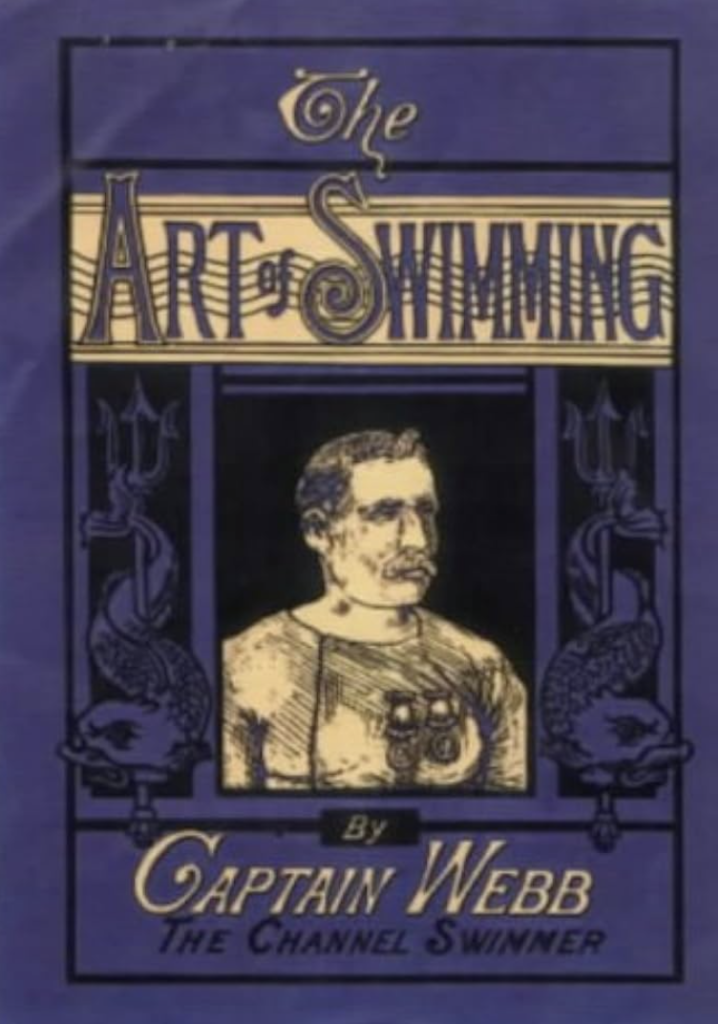
The Art of Swimming is a 111-page book published in 1875 that was authored by Captain Matthew Webb, the first person to swim across the English Channel from England to France without the use of artificial aids. The instructional book shared Webb’s pioneering endurance and survival techniques including the methods that allowed him to become the first person to swim across the English Channel.
In August 1875, Webb swam from Dover to Calais in 21 hours 45 minutes, inspiring and educating the world about marathon swimming. His feat was not replicated for another 36 years.
© 2026 Daily News of Open Water Swimming
“to educate, enthuse, and entertain all those who venture beyond the shoreline“
World Open Water Swimming Federation, a human-powered project
New Open Water Swimming Educational and Motivational Course – register here