
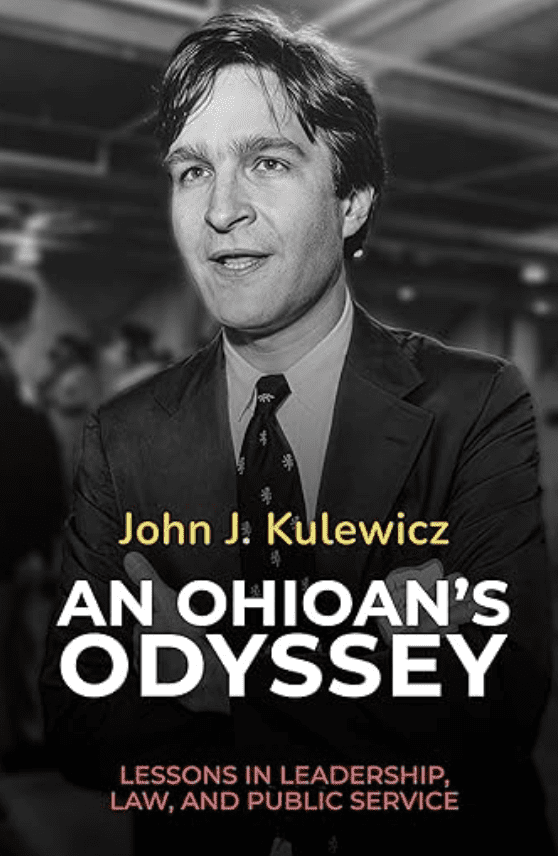
A few swimmers are bravely dipping their toes in the rough-and-tumble world of politics, including in the currently highly contentious United States.
John Kulewicz, an experienced open water swimmer, is seeking the Democratic nomination for State of Ohio’s Attorney General (see his campaign website here and here and read one of his opinions here). The position as a state attorney general serves as the chief legal officer and top law enforcement official for Ohio, representing the government in civil and criminal matters, providing legal advice to state agencies, and enforcing laws related to consumer protection, environmental protection, and civil rights. They protect public interests, manage the state’s Department of Justice, and may investigate local law enforcement or handle major criminal prosecutions.
Currently a city council member, Kulewicz is a graduate of the Ohio State University and Yale Law School, and a former partner at Columbus-based law firm Vorys, Sater, Seymour and Pease. Among his many legal victories, Kulewicz has argued and won difficult cases in the U.S. Supreme Court.
He said, “I swam in all 88 Ohio counties last year while going around the state to explore the run for Ohio Attorney General. It was a fantastic adventure. Ohio has a great wealth of aquatic resources, from the open water opportunities along the shores of Lake Erie (on which eight Ohio counties border) to the Ohio River, with lots of phenomenal community pools and YMCA pools in between. I highly recommend the Buckeye State as a destination for all swimmers. The 88-county swim exposed me to a wonderful cross-section of Ohioans and firmly grounded me in the issues and principles on which I am basing the campaign.”
In 2024, he wrote an article for Law360 about how his swimming experiences have made him a better lawyer: Swimming Makes Me A Better Lawyer.
Swimming Makes Me A Better Lawyer
I came to swimming later in life. But something felt familiar as I climbed onto the starting block for one of my first races. The adrenaline was flowing, yet I was calm and focused after watching the events before mine.
The crowd became quiet. The swimmers took their marks. The gun fired. The race began. I dived into the water.
Weeks of training made each stroke feel strong. The competition was intense. At the last turn, my closest competitor was shoulder to shoulder with me. Instinct kicked in.
I pulled barely ahead. My confidence surged. Gasping for breath at the end of the pool, I heard the announcement that I had won by seven one-hundredths of a second.
Not long after, it occurred to me that that swimming experience and others were not so different from an appellate oral argument. Months of patient preparation precede the intensity of the short time in the courtroom.
The process begins with weeks devoted to poring through the record and relevant case law. You focus on what the case will require. You look for what is important, both in the facts and the law. You identify doubts and obstacles, but find answers and concentrate on the objective.
In preparing the brief, you expose your arguments to challenges, often strenuous, from those who are working with you. You make the necessary adjustments to create a road map for the most effective presentation of the client’s position.
Preparations shift into high gear when the notice of oral argument arrives. You distill your argument into the key points that you want to make. You think of the questions that probing judges may ask. You prepare responses.
If you are especially fortunate, a team of talented colleagues will take you through several rigorous mock arguments.
The day of the oral argument arrives. The presiding judge calls your case. You approach the podium. “You may proceed,” the judge says. You might be nervous. But if you have done the necessary homework, a sense of calm prevails.
The argument begins to flow. Questions come fast. Your preparation allows you to anticipate them, and then to answer, explain and pivot back to the main point that you believe will best help the court understand the dispositive issue. Before you know it, the argument comes to an end.
Surprisingly, years of participation in swimming events, especially in the open water, have proven to be ideal preparation for oral arguments before panels ranging from the U.S. Supreme Court to federal and state courts in Ohio.
As with appellate oral arguments, you spend weeks or months preparing for a swim event. When the day comes, you feel much more composed as you head to the water if you have been able to devote the necessary time to training in pools and the open water.
You await the sound of the starting horn with the same anticipation as the invitation of the presiding judge to proceed. You enter the water as deliberately as you make your case in the opening remarks that follow “may it please the court.” You’re off and swimming, caught up in the intensity of the moment.
After that, as in oral arguments, preparation is the pathway to excellence.
Little contributes more to the successful outcome of an appellate effort than the caliber of the teammates who are working with the counsel of record in preparing the brief and the oral argument. The stronger their skills, the deeper their experience and the more avid their participation, the better the case will go for the client.
The same is true of the friends with whom you have swum in preparation for the swim event, and of the information, advice and coaching that you have been able to find.
That aspect of appellate work has led to a crucial rule of thumb in recruiting open-water teammates. I always look for swimmers who are faster and stronger than me (a considerable part of the swimming population).
The team is paramount. In the open water, as in preparing for an oral argument, “team” is a broad concept. It includes not only your fellow swimmers but also the pilots, crew, kayakers, veteran swimmers and advisers — as well as a supportive family — who are an integral part of the swim. Success depends upon the best efforts of all who are involved.
The swimming corollary of anticipating the judges’ questions is “expect the unexpected.” The swimmer must think ahead of as many eventualities as possible, but keep composure if something unexpected happens. If the water gets rough, sometimes the objective changes to just making it through the swim.
“Don’t let the demons get to you” is the other key rule of open-water swimming. In court, that means confronting your challenges and finding the plausible way to push through or around them. In the open water, it means to just keep swimming — despite fatigue, anxiety, jellyfish, other sea life, unwelcome weather conditions and other adversity.
Remembering the purpose is just as important. In the appellate process, the vindication of our client motivates and reassures us. Some open-water swims have their own intrinsic attraction, as I found when crossing the Strait of Gibraltar and the Bosphorus.
Others have had a commemorative purpose that has proved to be especially inspiring for my teammates and me — such as an English Channel relay to mark the 70th anniversary of D-Day, and a swim along the route of John F. Kennedy and the PT 109 crew in the Solomon Islands. Dedication to those goals keeps you going, especially if adversity arises.
Details make as much of a difference in open-water swimming as they do in appellate work. Familiarity and patience with administrative processes come in quite handy when filling out and coordinating the completion of the many forms that most open-water swims require — such as registrations, qualifying swims and medical certifications.
Above all is the willingness to put your trust in the hands of powers greater than yourself — the judicial process in the appellate scenario, and the ocean or other bodies of water in the swimming context. The swimmer, like the appellate lawyer, must develop a genuine respect for the environment in which he or she is functioning.
The resemblance of swimming events to appellate oral arguments has been a pleasant surprise to me. Just as I am thankful for the many appellate opportunities that have been given to me over many years now, I am grateful for the many ways in which the lessons of appellate work have contributed greatly to the satisfaction of swimming.
I did not know it in the beginning, but they have proved to be a template for years of exciting aquatic adventures around the world.
John Kulewicz As An Open Water Swimmer
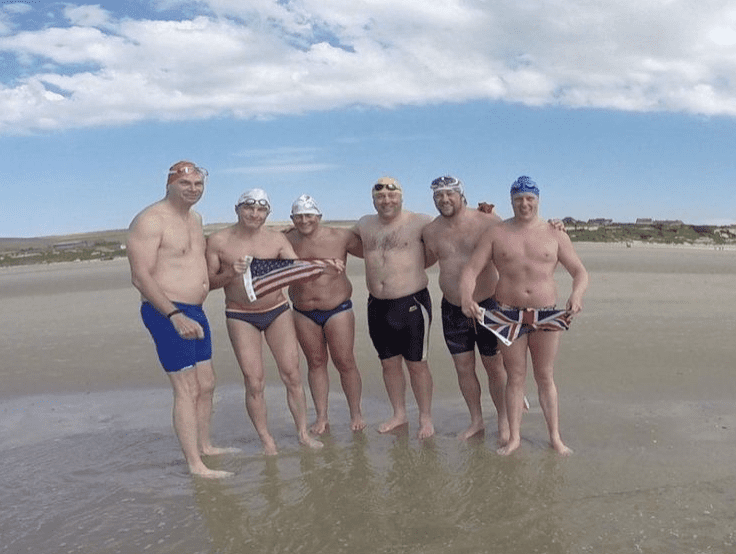
Among his many open water swims, he was a member of the Overlord 70 and Over There! relays that separately crossed the English Channel, the Bosphorus Cross-Continental Swim in Turkey, crossings of the Strait of Gibraltar, Lake Memphremagog, the Sea of Galilee, the Hellespont, and organized the PT 109 Swim, an ocean swim in the Solomon Islands, together with Jack Lundberg, Adrian Mula, Rich Lovering, Peter Canfield and Jay Madigan.

© 2026 Daily News of Open Water Swimming
“to educate, enthuse, and entertain all those who venture beyond the shoreline“
World Open Water Swimming Federation, a human-powered project
New Open Water Swimming Educational and Motivational Course – register here