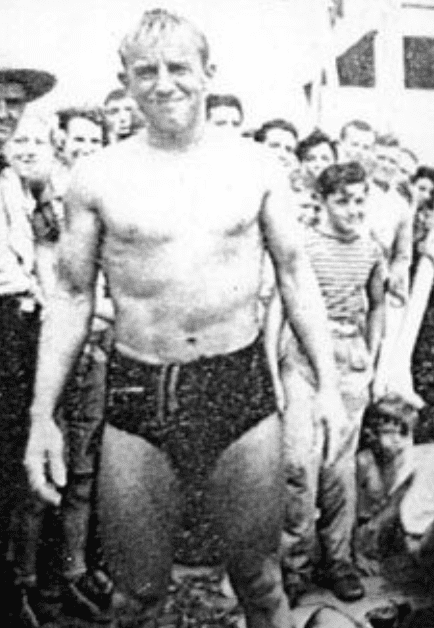

Steve Wozniak (USA, MSF bio here) was inducted as an Honor Swimmer in the International Marathon Swimming Hall of Fame in its Class of 1979. He was a cement truck driver by profession who eventually enjoyed a prolific 50-year marathon swimming career.
Over the decades, he completed the 41.8 km Atlantic City Centennial Swim in 1954 and the 32 km Traversée internationale du lac St-Jean, won the 1948 Canadian National Exhibition race and the 54 km Nile River Swim in Egypt in 1956, raced along the 88 km Parana River in Argentina in 1961, finished in podium positions in several 36 km Around-the-Island Marathon Swims in Atlantic City, swam 14.4 km around Buffalo Harbor with his legs tied at the age of 71, the year he died while planning for his final English Channel crossing.
Earlier in 1980, the 64-year-old Wozniak developed chest pains while training for his second attempt of the English Channel. He went for a medical check-up and had immediate heart surgery that required five artery bypasses and an implant of an artificial valve in his heart.
Despite that surgery, he never gave up his dream of crossing the English Channel and continued to train. He continued to train, but his heart problems resurfaced and he passed away seven years after his heart surgery.
The Importance of CPR
The importance of CPR (or cardiopulmonary resuscitation) is well known in the open water swimming community.
At International Ice Swimming Association-sanctioned events, strict medical screenings including ECGs (electrocardiogram), heart rate and blood pressure checks are required to monitor heart health of the ice swimmers. The medical screenings are designed to prevent issues related to cold-water shock and high cardiovascular strain, such as arrhythmias or heart attacks.
Governing bodies of channel swimming around the world require medical requirements that necessitate a physician’s involvement before solo crossings. These include questions about the swimmer’s heart, lung, and metabolic diseases.
For local races in lakes, rivers, seas, bays, and oceans, there are always lifeguards and race officials overseeing the competitions who are qualified in CPR.
Hands-Only CPR
Swimming and CPR are two skills that can not only save your own life, but also the lives of others. CPR plays an essential role in the overall safety net that encompasses the entire open water swimming community.
It is essential for swimmers, officials, and volunteers who are involved in open water events or ice swimming competitions, or who serve as escorts in boats or kayaks during channel crossings, to know about and be able to use Hands-Only CPR (i.e., where only hands are used without any mouth-to-mouth resuscitation). Swimmers, coaches, family members, or friends may be called upon to do Hands-Only CPR on a shoreline, on the deck of a boat, or in any number of unexpected locations at any number of unforeseen times.
Every year, more than 350,000 cardiac arrests occur outside of the hospital, and more than 20 percent occur in public places like airports and sporting facilities in the United States. This included an alarming number of episodes in the global open water swimming community prior to 2009.
Hands-Only CPR Kiosk
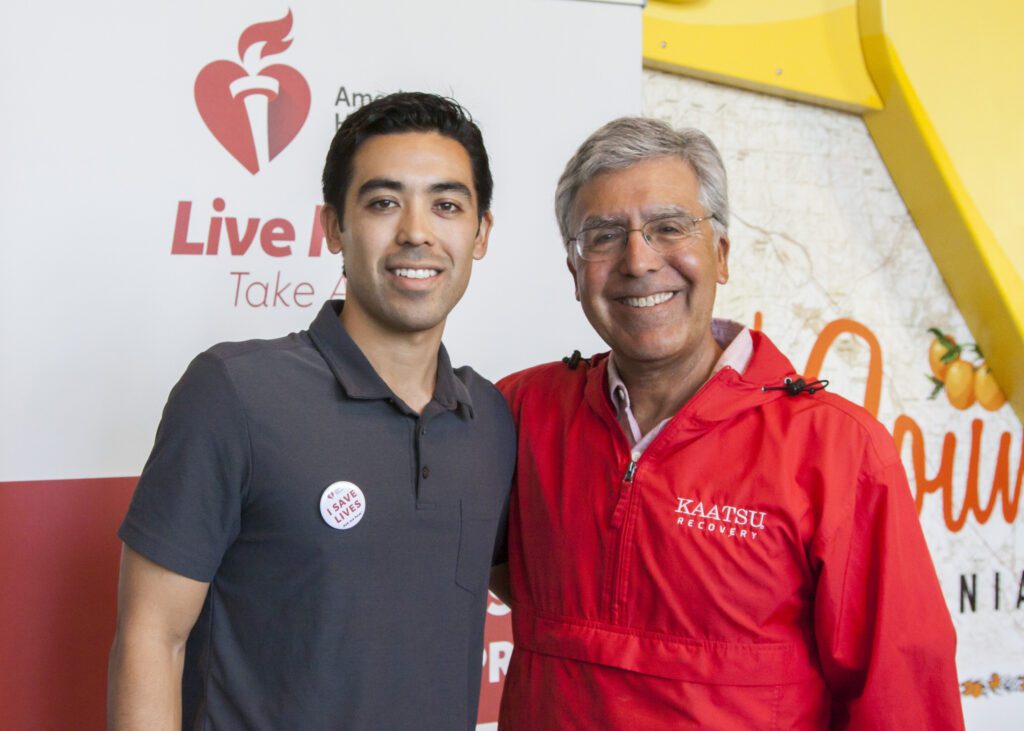
Today at the Discovery Cube in Santa Ana, California, Edwards Lifesciences Foundation continued its support of the American Heart Association by unveiling a new mobile Hands-Only CPR kiosk. The kiosk helps users understand how they can immediately help a person experiencing a cardiac emergency outside of a hospital.
Every year, more than 350,000 cardiac arrests occur outside of the hospital, and more than 20% occur in public places like airports and sporting facilities.
The mobile kiosk enables people to learn about – and very importantly, practice – Hands-Only CPR, followed by a practice session and a 30-second test session. With the help of a practice manikin, the kiosk gives feedback about the depth and rate of compressions and proper hand placement – factors that influence the effectiveness of CPR. The entire training takes 5 minutes or less. Over the next three years, the mobile kiosk will be placed in 9 locations in Orange County.


“Cardiac arrest remains a leading cause of death in the United States, and survival depends on immediately receiving CPR from someone nearby,” said Todd Brinton, MD, FACC, Corporate Vice President, Advanced Technology and Chief Scientific Officer. “Edwards Lifesciences is proud to bring the Hands-Only CPR training kiosk to Orange County providing free training that can make a difference and save lives.”
A ribbon cutting ceremony was held in coordination with launch of the mobile kiosk at the Discovery Channel where the experience of two ocean swimmers Skyler Munatones and his father Steven Munatones were featured as an example of the vital importance of Hands-Only CPR in unexpected situations.


“90% of cardiac arrest victims die, often because bystanders don’t know how to start CPR or are afraid they’ll do something wrong,” said Pranav M. Patel, M.D., American Heart Association Orange County/Inland Empire Board President and Chief, Division of Cardiology, UC Irvine. “Bystander CPR, especially if administered immediately, can double or triple a cardiac arrest victim’s chance of survival, which is why the Hands-Only CPR education available at the kiosk is so valuable. In just a matter of a few minutes, people will learn a skill that can potentially make a difference in the lives of friends and those they love.”
Ten years ago, 17-year-old Skyler was eating breakfast at home when his father collapsed with a widowmaker, a heart attack caused by 100% blockage in the major blood vessel supplying the front part of the heart. A blockage in the left anterior descending artery is particularly lethal, potentially causing catastrophic heart tissue damage and leading to a fatal cardiac arrest due to disrupted blood flow and abnormal heart rhythms. Not only is prompt medical attention crucial to survival, but so is also Hands-Only CPR.
Saving A Life with Hands-Only CPR
Anyone Can Become A Hero
“The kiosk will help the public understand how simple it is to perform the two steps of Hands-Only CPR, which will hopefully help reduce some of the trepidation that people have about performing bystander CPR,” said Amanda Fowler, Vice President, Global Corporate Giving, Edwards Lifesciences and Executive Director, Edwards Lifesciences Foundation. “After completing the kiosk training, we hope people will feel empowered knowing they are taking the first steps in learning a critical skill.”
Because when you can save someone’s life, the gift of life is the most precious thing you can give.
© 2026 Daily News of Open Water Swimming
“to educate, enthuse, and entertain all those who venture beyond the shoreline“
World Open Water Swimming Federation, a human-powered project
New Open Water Swimming Educational and Motivational Course – register here