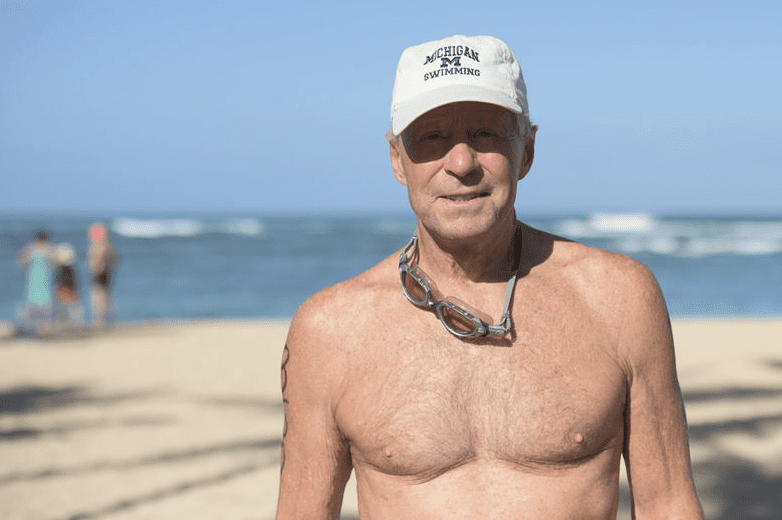
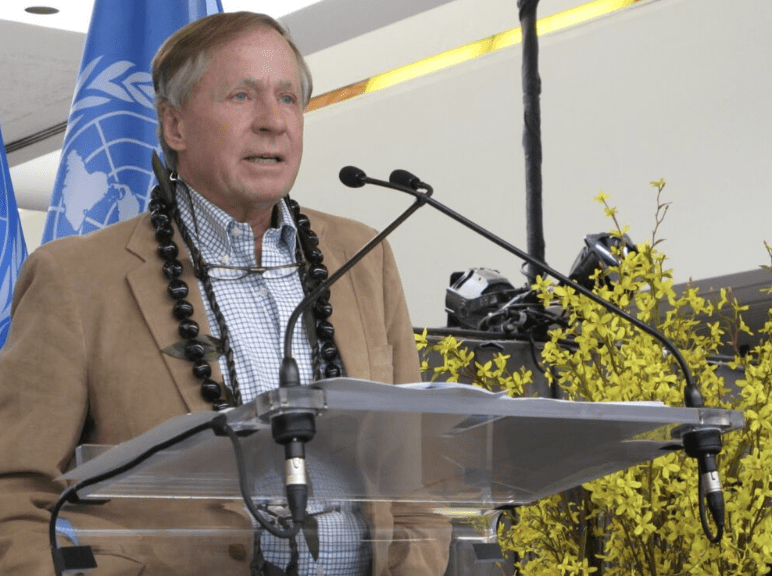
Dr. Harry Withers Huffaker (MSF bio here), a retired dentist, passed away on January 29th at his home in Hailey, Idaho, with his sweet labradoodle Ruby, his life partner Barbara Kline, and his friend of 82 years, Dr. Mike Fenlon, at his side. The Honor Swimmer in the International Marathon Swimming Hall of Fame (Class of 2011) was 86 when he took his last breath.
While his life began simply enough, Dr. Huffaker had an adventurous soul where the world’s oceans and the outdoors was his constant playground and testing grounds.
Early Life
Dr. Huffaker was born on December 27th 1939, in Long Island, New York, the second son of Melvin Simpson Huffaker and Dorothy Perkins (Dufo) Huffaker. The family moved to Grosse Point, Michigan, a year later where Melvin Huffaker practiced law and Dorothy was a homemaker.
After graduating from Grosse Point High School where he excelled at swimming, Dr. Huffaker attended the University of Michigan, swimming on their elite 1957 swim team and graduating as a State Swim Champion. One of his teammates was famed Olympic coach Jon Urbanchek. They spent a lot of time in the pool and, in Dr. Huffaker’s case, in the classrooms and libraries. He remained an avid Michigan Go Blue alumni for the rest of his life. He continued his education at the University of Michigan Dental School, graduating in 1966, and moved to the Island of Oahu, Hawaii, to practice dentistry.
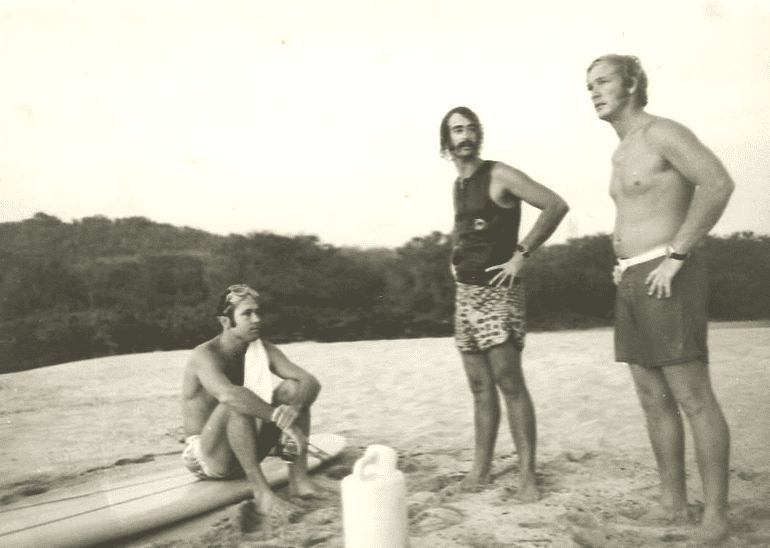
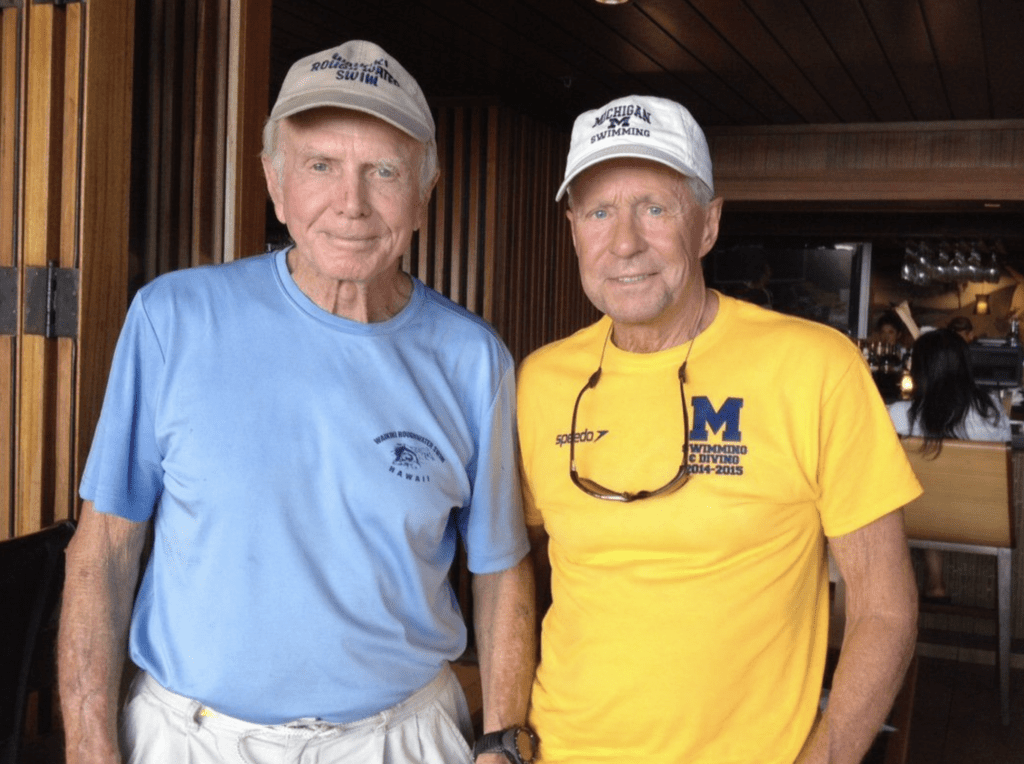
Channel Crossings
After two nearly-successful swims across the English Channel in 1963 and 1964 which ended just short of the French coast due to hypothermia, Dr. Huffaker began swimming in the much warmer waters of Hawaii – where he continued to look towards the distant shores. He became a famed Hawaiian Island marathon swimming pioneer showing great perseverance and courage.
A member of the Hawaii Swimming Hall of Fame (Class of 2002), he also served time as a Vice President in the Channel Swimming Association.
During his September 1967 Molokai Channel swim from Molokai to Oahu, he saw a large shark underneath him and immediately headed for his escort boat, but the shark then swam between him and his boat, which was too far away for an easy escape. He did not panic, took some calming breaths, some breaststroke, and ultimately continued on, ultimately reaching Oahu after 13 hours 15 minutes.
In 1970, he pioneered the 47.6 km crossing of the Alenuihaha Channel from the Big Island of Hawaii to Maui in a tough 20 hours 8 minutes. Hawaiian Island channel crossings in the 1960s and 1970s were filled with uncertainty and unknowns as his first attempt ended in failure after 17 hours.
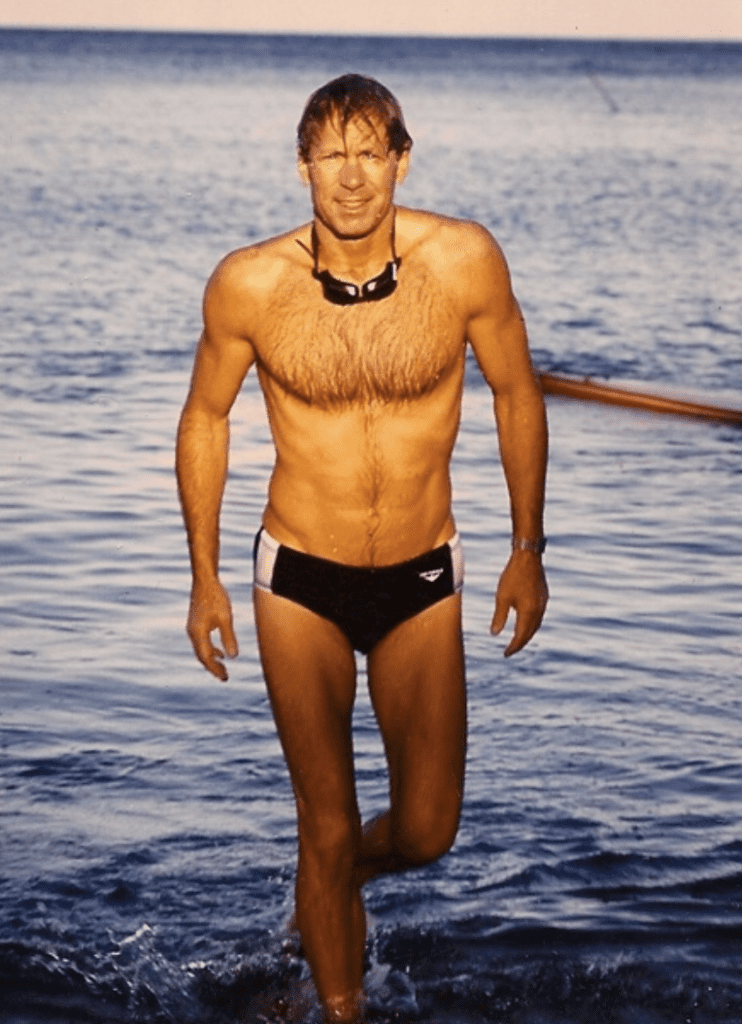
In September 1972, he completed a second 45 km crossing of the Molokai Channel, this time in the opposite direction, taking 16 hours 15 minutes [photo above shows him at the finish on Molokai]. His first attempt in this direction ended after 20 hours where he ran into strong currents, a tiger shark and a brood of Portuguese man o war. With only Keo Nakama making the crossing before him in 1961, Dr. Huffaker was one of the early pioneers of interisland crossings.
At the age of 50 in 1989, he swam from Lanai to Maui, then Maui to Molokai, then attempted to complete his final Molokai-to-Maui leg before being pulled after 18 hours. His unprecedented 63 km 3 Islands Swim was aborted after 31 hours and 35 miles. But 30 years later, he helped plan the 63.9 km Maui Nui Triangle Swim pioneered by Becca Mann in August 2019, completing the triple crossing in 20 hours 53 minutes.
Over the course of his career, he swam the Maui Channel three times, was the first person to cross the 9.3-mile Kalohi Channel from Molokai to Lanai in 1989, crossed the 8.5-mile Palilolo Channel from Maui to Molokai in 1989.
His exploits were recognized by the International Marathon Swimming Hall of Fame at the United Nations in New York.
His partner Kline recalled, “He faced scary night swims, sharks, jellyfish, massive ocean swells, and extremely strong currents during unprecedented swims in the tropical waters of Hawaii as he conquered the major channels of the Hawaiian Islands. He was honored for his solo swims between the islands of Oahu, Molokai, Lanai, Maui, and Hawaii and has supported many other swimmers along the way.”
“As I sat in his dentist chair over the year, Harry used to tell me about all his attempts and successes,” recalled Steven Munatones. “This was the only time in my life that I did not want my dental visits to end. I just listened with great respect. Harry represents all that is admirable and unique in the sport of swimming.”
Post-Swimming Career
Dr. Huffaker was also an avid sailor and sailed solo from Tahiti to Oahu. He also ran the Honolulu Marathon, the Boston Marathon, and many other marathons. After 30 years practicing dentistry in Hawaii, Dr. Huffaker retired to Ketchum, Idaho, to pursue his love of outdoor sports. He traveled extensively from the Himalayas to Antarctica and all parts in between.
Despite his adventures, it was clear to all his friends that what he cherished most in his eventful life were the friendships he made and nurtured. He will certainly be missed for his unending supply of jokes, good humor, his compassion, his quick smile, and gentle laugh.
Memorial
A memorial will be announced later. Dr. Huffaker will be cremated with his remains to be scattered in Hawaii in the ocean fronting the Outrigger Canoe Club and in Idaho on Bald Mountain. In lieu of flowers, donations can be made to the Mountain Humane Society in Hailey, Idaho.
Ballycaste and Bryan in 1964
Dr. Huffaker spoke fondly of Bryan Finlay, PhD and his memories in Ballycastle, a small seaside town in County Antrim, Northern Ireland. It is on the north-easternmost coastal tip of Ireland, in the Antrim Coast and Glens Area of Outstanding Natural Beauty. “I thought this unanticipated night might be enjoyed by other adventurous types who subscribe the road less travelled.
There has been much water under the bridge and over the dam since Bryan and I first met each other in Ballycastle, Ireland. One of the most memorable events of my then young life at 24 years of age included a most memorable cast of characters who had gathered in Ballycastle for a race in 1964. The group included Kendall Mellor, Michael Jennings, Cdr. Gerald Forsberg, a tall upstart nearly 7-feet tall whose last name started with G, my father, and Kendall Mellor’s sponsor Tommy Holmes who owned a junkyard and transported us to the event in a beautiful red Jaguar sedan, and others.
After arriving in Ireland, our first order of business was to establish what time the pubs close. We flagged down a bobby who was pedaling a bicycle along the rural road that we were on. His answer to our query was, ‘I don’t know for certain, but I reckon sometime about the middle of October.’ We laughed and that set the tone for the next two days.
Local residents graciously provided comfortable lodging for the entrants and their entourages in their private homes. By the time dawn arrived the following morning, the town had doubled in size from 2,000 to 4,000 people along with a parade and modest marching band. The event was sponsored by Rothman’ cigarettes and people began to place bets on which swimmer they thought might win. Around noon, the race was cancelled after the temperature at the water’s edge was recorded at 9.4°C. The swimmers wasted no time getting back into their street clothes and heading to a nearby waterfront hotel for lunch and libation in an underground setting.
The afternoon wore on hour after hour without any discussion about or indication that it would ever end. At one point, I asked the person next to me if he thought we should be concerned about a police raid. His reply was, ‘No worries mate, there both in here with us.’
When we finally emerged from the smoke-laden environment to head back to our room, a clock on the wall indicated that it was 4 am and the second hand was still moving which I took it to mean that the clock was not broken. In retrospect, my main takeaway from the day – in addition to my gratitude for the race being cancelled – was that most everyone in Ireland has a friendly nature and a beautiful singing voice.
Nearly 60 years following that experience, I returned to BallyCastle following the International Marathon Swimming Hall of Fame reunion in Cork to revisit the scene at the 2014 Global Open Water Swimming Conference. It has been said and written that one can never return home. BallyCastle is a noticeable exception with very little change in evidence and the large seaside hotel is still there. I bellied up to the bar for a pint before heading off to our next venue which was the Bushmills distillery.”
Three Islands Swim
In 1989, Dr. Huffaker attempted a 63 km swim that had never been attempted before: the 3 Islands Swim or the Maui Nui Crossings between the islands of Maui, Lanai, and Molokai in the state of Hawaii. While he was ultimately not successful, his swim was supported by Rotary Club where Dr. Huffaker was a member. “The Rotary Club sponsored the swim on behalf of the Hawaii Rotary Youth Foundation to use for college scholarships for graduating Hawaii High School seniors. The hoped-for goal was to raise US$50,000.
But the final tally was US$225,000. Thirty years ago that was real money!” [Note: that is US$590,000 in 2026 value.]
He explained his plans, “My route started at Club Lanai and proceeded to Maui – which is the typical route of Maui Channel Swim. Then our plan was to swim from Maui to Molokai and then return from Molokai to Lanai. The most uncertain and challenging aspect was that the route involves different points of sail – the sea state, winds and weather in one channel can be quite different than those in the other channels.
The Lanai-to-Maui segment was perhaps the most pleasant swim I have ever enjoyed. [I swam] without a trace of wind in a flat sea state and a sky full of stars. Each time I placed a hand in the water a beautiful phosphorescence illuminated the water. With a mere raising of the eyes above the water’s surface, I could see the lights of Maui dead ahead. [It was] pure Heaven.
But the marine paradise soon transitioned as is expected in any Maui Nui Crossings.
He described his experience, “Shortly after heading off to Molokai, the weather changed rather dramatically, pushing me off course and changing my hoped for landing spot as well as adding another 2 hours to finally making landfall. This made landing on Lanai in daylight improbable. In itself, that would normally not matter to any great extent, but having previously experienced swimming across a reef a short distance off the Lanai coastline (aka Shipwreck Beach that is known for its strong currents and multiple shipwrecks) with about 18 inches of water along with small craft/high surf warnings, the swim was aborted due to safety reasons [see video above].
I was still in good shape physically and mentally, enough to climb into the zodiac under my own power.
Then we headed back to Maui with the escort boat for dinner on Ka’anapali and return to Oahu around 3 am and another day of work at the office. The morning paper was delivered at 5 am with banner headline reading “SWIMMER GIVES UP”. That was rather disconcerting as it did not properly portray the whole story. I gave the paper a swift kick down the hall and went about my day.”
The direction of the swim between the three islands was left to the oceanographers who were on the swim. Dr. Huffaker recalls, “One of the oceanographers was Karl Bathen, a professor from the University of Hawaii, and the other was Dr. Ricky Greg, one of the first big wave servers who had a Ph.D. and who authored a number of books written about oceanography.
Perhaps the first leg from Lanai to Maui was selected first because it was the well-traveled route for the Maui Channel Swims. And having swim from Molokai to Lanai with no real difficulty regarding currents etc. other than the reef with very little water over it. From a logistics standpoint it would be appealing and easier to begin and finish the swim on Maui.”
Remembering Keo Nakama
Dr. Huffaker recalled in 2016, “For me, the news of Keo Nakama’s passing was very sad news. In 1961 Keo, became the first person to swim across the Molokai Channel. When I moved to Hawaii in 1966, I was just getting my feet wet with channel swimming.
At that time Hawaii had a one-year residency requirement for people to become eligible to take state board exams to obtain a professional license. I passed the time selling cars, teaching swimming and working in an children’s dental clinic at Palama Settlement for which a temporary dental license could be obtained.
In lieu of any other personal or professional responsibilities, I began training to duplicate Keo’s feat. When I got off the plane in Honolulu, I knew two people who lived there. After seeing an article in the paper about my channel intentions, Keo telephoned me and invited me to lunch. During lunch, he offered to answer any questions I had in addition to an offer to assist in any capacity which might be needed.
After my crossing in 1967, he took the time to write a very nice congratulatory note. Over the years, our paths crossed occasionally.
Three years ago [in 2013] during a return visit to the islands I decided to seek him out. The search led to a rather deplorable old structure in the form of a Chinese nursing home. There were only a handful of people in residence. Upon walking in I found him sitting alone in a large room. My heart sank. I had been looking forward to a pleasant visit along with an opportunity to say thank you for the interest he had taken in me years ago.
I attempted to rekindle his memory as to who I was and why I had come to see him. A rather lengthy period of gesturing, providing him with a calling card, drawing a map with paper and pencil followed. His face suddenly lit up and he stood up and gave me a big hug. After a brief time of hand-holding, I got up to leave. When I got to the door, I looked back through watery eyes and waved goodbye. He also had a few tears running down his face along with his infectious smile.
Keo was small in stature, but it never let it stop him beating any and all comers and towering over others. He was an easygoing, soft-spoken man with a tantalizing smile who was very modest and a real honor to know.“
Meeting Peter Frayne, Assistant Secretary of the Channel Swimming Association.
Dr. Huffaker once shared a letter dated December 28th 1963 written by Peter Frayne about his attempt on the English Channel. The letter gave insight into the bygone days of Channel swimming over 60 years ago.
“It was in July, the telephone range and “Is that Mr. Frayne?” I wanna swim the Channel,” was my first introduction to Harry Huffaker, American Extraordinary.
Within an hour I was to meet what seemed to me (and I have a vast experience of these types, having pounded the best in the Gateway of English for over 17 years) a typical student, bumming his way round the world just for kicks. Sneakers and sweat shirt, jeans and a jerkin, 4-day stubble and a wide smile – that was Harry.
I sized him up in an instant – this lad just didn’t know the enormity of the task – wait until I told him what it cost – how much he would have to train – then he would change his tune. So I let him have it. A boat and pilot will cost you £75, and more if you use him for training; accommodation is not cheap and not easy to find, you will need extra food and the Channel Swimming Association fee is 8 guinea. You will have to train until it hurts, and is that water cold. Within a couple of weeks, you will have to stay in the water for 2-hour spells and later on sprinkle in a few 4-hour stints, and then if you can manage it – a 7-hour turn. All this before you can seriously think you have a chance. I told him of the flood and ebb tides, either of which can take you miles off course. And, I said, “You have to be a pretty good performer to start with.”
“I can swim,” says Harry with quiet confidence. “I swam for my college, I still want to have a go.” Was I mistaken, was this young man really in earnest, had he got what it takes. He was soon to show me.
The next day, he applied for, and got a part-time job at a hotel with food thrown in; a room in a boarding house near the seafront and has acquired a track-suit. And what is more, he showed me his prowess in the harbor. For someone who has not swum competitively or trained for over a year, the performance was first rate. His speed through the water compared favourably with an extremely fast Pakistani long distance swimmer who had been in constant training for years. Yes, this fellow had something – but would he keep it up? He did.
Harry got stuck into the arduous task of bashing up and down the harbor in the still, very cold water of the English Channel, knowing that he had to accomplish in two months, what most aspirants would build up to in 12. In fact, Comdr. Gerald Forsberg (our President) who broke the England-France record in 1957, trained for 2 hears for this swim in mind. So little time with so much to do, but it didn’t daunt our Harry. Within a few weeks, he was swimming marginally faster than our Pakinstani friend. To speed up his training, he got a job at a near-by holiday camp that boasted a swimming pool. Naturally he was the swimming instructor, but I have a sneaking feeling that most of the instruction was on himself.
Than of all things, out of the blue, Harry got married. How could such a thing happen to one of my swimmers? I was stunned. It was unheard of. A swimmer, in the middle of his training to swim the Channel, getting married. But it didn’t upset the schedule as I thought. His wife, Chris, urged him to even greater efforts, and Harry responded. His parents too, who at a moments notice flew to England for the wedding, were as keen as mustard and stayed on for the big swim. Every day you could see Papa Huffaker walking along the seafront, stopwatch in hand, gazing out to see at Huffaker Junior punching through a loppy sea.
Training sessions were stepped up – a long swim in the open channel organized, but enthusiasm cannot replace experience, and time cannot be replaced by tenacity. And experience, and time were two things that Harry did not have. There never will be a short cut in training for what is one of the premier marathon events in the world. The four successes in 1963 showed this. Each one had a history of long and arduous training behind him and the experience of other long distance events to boot. Whoever heard of a sprint swimmer making his debut into long distance swimming with a bash at the English Channel? But that’s your Harry.
At 5.55 a.m. 14th September, goggled and greased on Gris Nez beach, he stood with Abdul Malek and waded into the cold surf. Conditions were fair to good and hopes ran high. But the sages were right, damn them. No-one, no matter how good, could succeed in the Channel at the drop of a hat. It was a valiant swim. It could not be called a failure.
I saw Harry in the local hospital an hour after he was landed at Dover. Still greasy and tracksuited and that Channel look in his face. I could see that he had had a beating. Those waves smacking you in the face can be cruel. But although disappointed, he was not downhearted. “I’ll do it next time,” he told me. He learned a lot during that swim, and I believed him.
This man has the potential of a top class long distance swimmer, who would shine especially in tidal swims where his speed would be a vital factor. Given the time to train sufficiently and free from financial worries, I can see Harry contending for top honours in any international long distance event he cares to enter. I sincerely hope he has this opportunity.“
The Last Moments
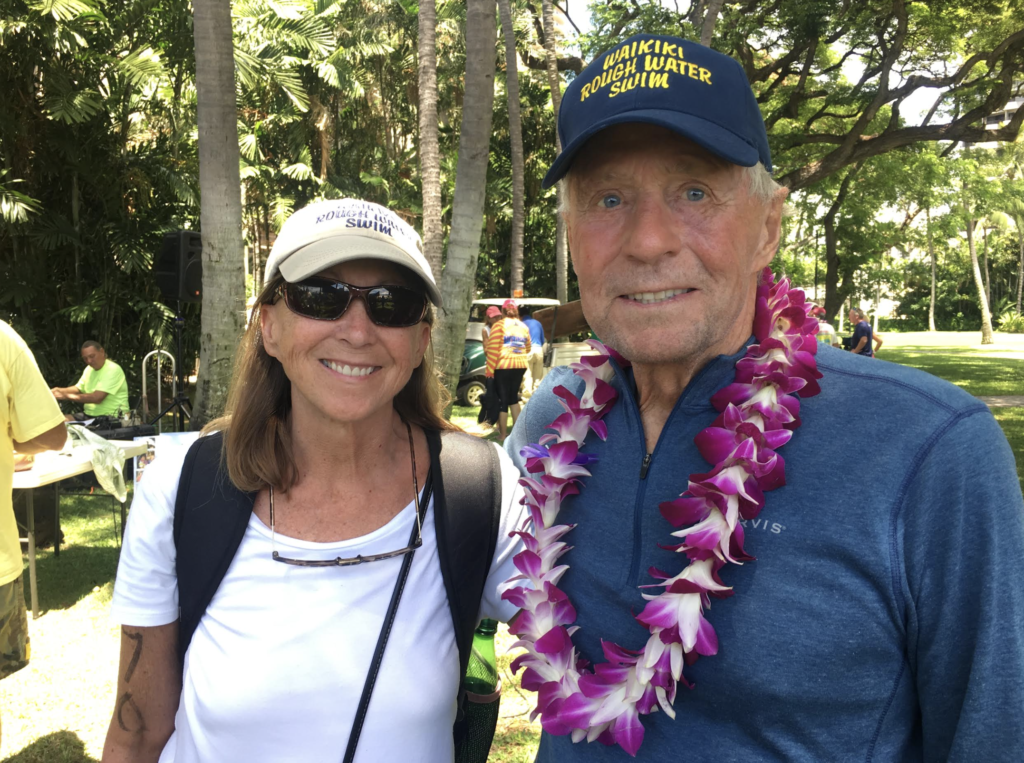
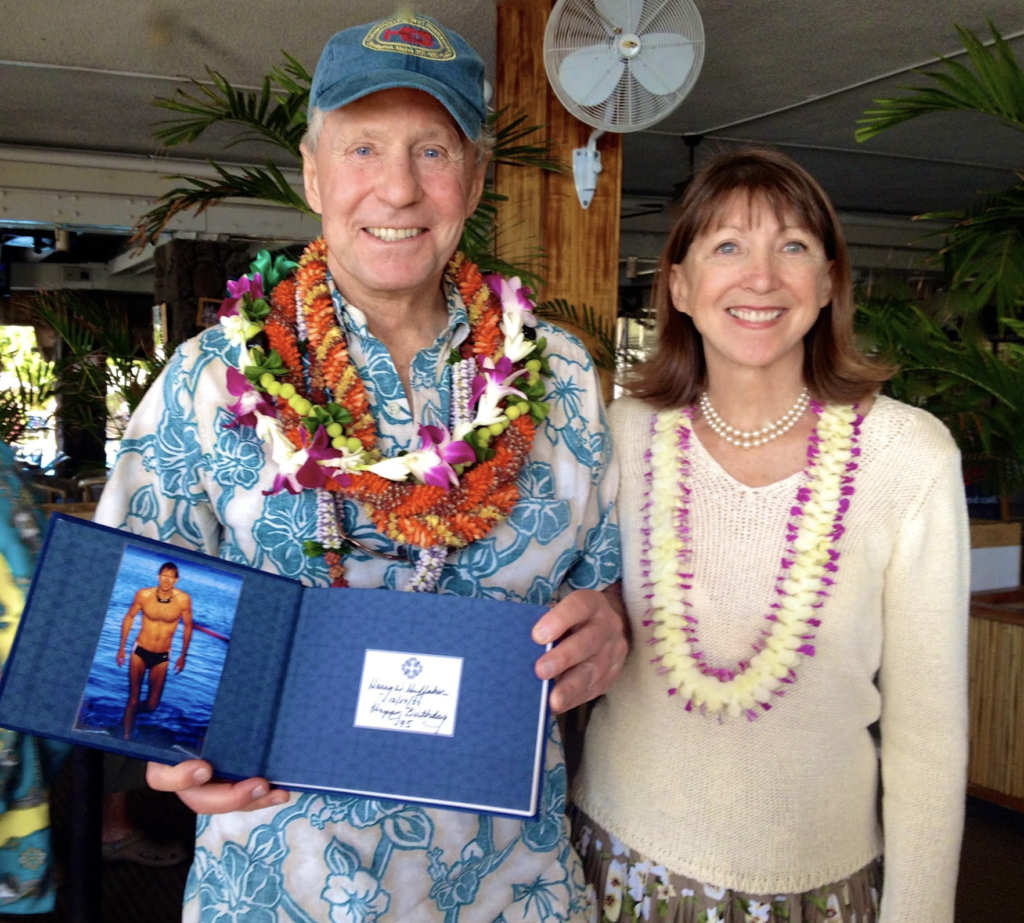
Barbara Kline (shown below at his 75th birthday) recalls, “We were home. I was sitting on the bed with him and his best friend from since he was 5 years old in Grosse Pointe, Michigan, Dr. Mike Fenlon was sitting next to him and our little dog, Ruby. We both got up and said, ‘Good night Harry we are going to bed and we love you.’
We then heard him stop breathing and went back to him and he was gone.
Harry was able to hear from a couple close friends, Chris Duplanty, an Olympic water polo player had talked to Harry the day before and told him what a great influence he had been on him both as a swimmer and as the person he became. It was very touching.
There are so many stories like this and people he inspired in life and in swimming. Other close friends had also sent messages of love over the last few days. The heartfelt memories are pouring in with the sentiments of love and admiration so many people felt for Harry. Harry was at peace and content with a life well lived which gives me happiness to know he was so loved by not just me, but many.”
© 2026 Daily News of Open Water Swimming
“to educate, enthuse, and entertain all those who venture beyond the shoreline“
World Open Water Swimming Federation, a human-powered project
New Open Water Swimming Educational and Motivational Course – register here
This is a wonderful celebration of a spectacular life lived to the fullest. Harry’s passion for living is an inspiration for all of us. Thanks for the memories, Harry, there will never be another like you….Fritz
What a life Harry lived! I am a better person for having known him. There areno words to express my deep respect and admiration I had for him. My condolences to Barbara and Ruby.