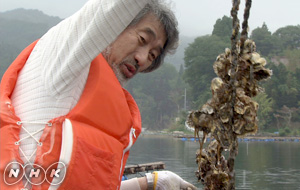
 Due to the devastating earthquake and tsunami in 2011 in Japan, oyster farmer Shigeatsu Hatakeyama was wiped out. Tons of mud and rubble destroyed his oyster farms, his home and everything that he and his previous generations had developed in Japan. He also lost his mother.
It was a disaster on all levels for Hatakeyama, but it ultimately led to more exposure of his quiet and tireless work to help improve the health of the sea around him in northern Japan.
But the man whose psychological roots are deeply embedded in the sea started over again from zero. He found, surprisingly, that found that his oysters grew back twice as fast as normal. “The ocean always comes back,” he explains. “Rather than confront nature, we accept it.”
He also knew that an abundant amount of nutrients in the surrounding waters helped his oysters grow. Specifically, the rivers that flowed into the Pacific Ocean near his farms were essential to the health of his oysters near the sea. And the health of the rivers are partly based on the forest through which they flow. So he started to plant trees. Many of them. Thousands of them.
Over 23 years, Hatakeyama has planted more than 20 000 trees upstream. His work – with the goal of improving the aquaculture downstream – has been tiring and time-consuming. And he looks out 50, 100 years into the future when the trees are more mature and the fruits of his labor will benefit future generations. “We protect the forest in order to protect the sea.”
He founded Kaki no Mori wo Shitau Kai (Society to Protect Forest for Oysters) and Mori wa Umi no Koibito (The forests are lovers of the sea), serving as the backbone of his campaign to improve the forest, the rivers and the sea downstream. Besides his physical labor, he also endeavors to instill inspiration and educate the future generations. His work and his movement with his non-profit organizations has been featured in textbooks for elementary and middle school students. He also welcomes children from all over Japan to his oyster farm to provide them with environmental education opportunities.
Copyright © 2012 by World Open Water Swimming Association